
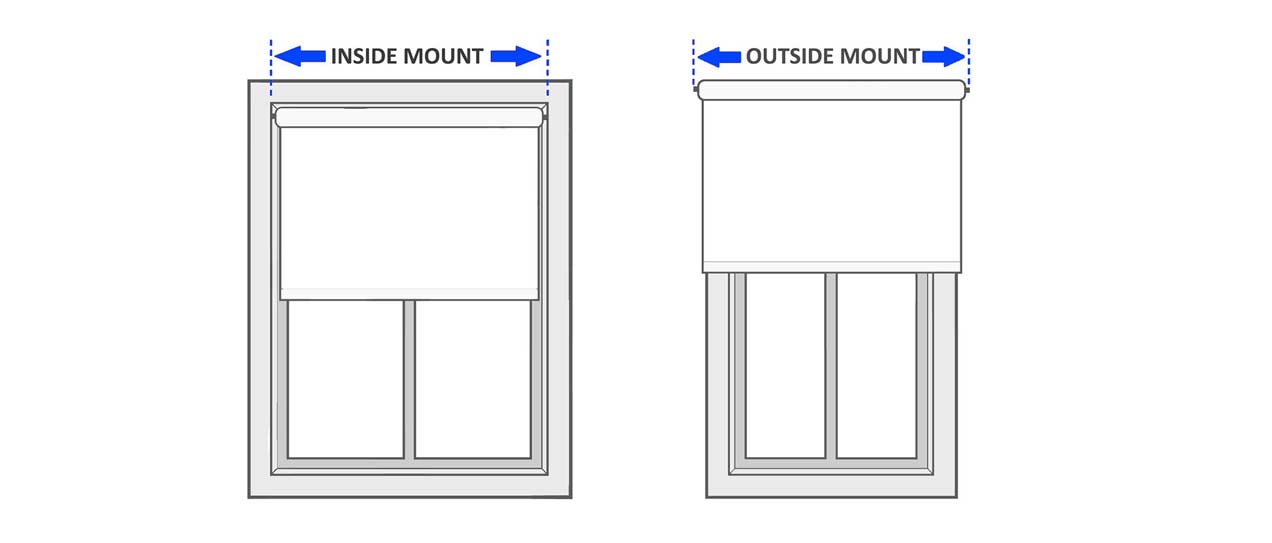
Most window covering complaints we hear after the fact trace back to a measurement that was not quite right. Half an inch of width is the difference between a covering that will not go in and one that will not seal. Reading inside-mount as outside-mount produces something that looks correct from the doorway and wrong from the sofa. None of it is difficult — it is just unforgiving, because the covering is cut to the numbers you hand over and cannot be cut again.
If a consultant is doing the order, the measuring is ours and so is the mistake. Read this anyway: it is what lets you check a quote, sanity-check a measure, and understand why the answer to a simple-sounding question is sometimes another question.
The Short Answer
Decide inside or outside mount first, then measure three times across and three times down, with a steel tape, to the nearest sixteenth. Take the narrowest width and the longest height for inside mount. Record exact fractions and never round.
The part that catches people is not the arithmetic — it is assuming the window is square. Very few are.
Why an Eighth of an Inch Matters
Window coverings are made to order. The manufacturer cuts fabric, machines hardware and assembles to the numbers on the form, and there is no adjustment afterwards. Custom orders are also not returnable for measurement error, which means a wrong number is a remake somebody pays for — and if the measurement came from the homeowner, that is the homeowner.
Fit is not the only casualty. An undersized covering leaks light down both edges, which defeats the entire point in a bedroom. An oversized one binds against the frame, and a covering that binds is a covering whose mechanism wears out early.
What You Need
- A steel tape. Cloth and vinyl tapes stretch under tension and will give you three different answers for the same window.
- A level — to find out whether the opening is actually square before you trust it.
- Paper, not memory. A form from the provider is better than one you invent, because theirs has the fields you would forget.
- A step ladder for anything tall. Measuring at full stretch is how the top number goes wrong.
One thing that is easy to miss: frames move a little with temperature. Measuring an exterior-wall window on a very cold January day and installing in July can matter on a tight inside-mount fit.
Inside Mount or Outside Mount
Everything else follows from this, so settle it before the tape comes out. The two produce different measurements and different-looking rooms.
| Inside mount | Outside mount | |
|---|---|---|
| Where it sits | Recessed within the window opening | On or above the trim, covering the opening |
| Look | Trim stays visible; clean and architectural | Window reads larger than it is |
| Requires | 2 to 4 inches of frame depth, and a square opening | Wall space around the opening |
| Light leak | Some, down both edges | Least — the covering overlaps the frame |
| Choose it when | The opening is square, deep enough, and the casing is worth showing | The frame is shallow, the opening is out of square, blackout is critical, or the window wants to look bigger |
Most houses end up with both, decided window by window on the conditions rather than as a whole-home style choice.
Measuring for Inside Mount
- Width, three times — top, middle and bottom of the opening. Record the narrowest.
- Height, three times — left, centre and right. Record the longest.
- Depth — at the shallowest point, to confirm the product will actually fit inside the frame.
- Both diagonals — corner to corner, each way. They should agree within an eighth of an inch. If they do not, the opening is out of square and you are probably looking at outside mount.
Hand over the raw numbers. Do not subtract anything for clearance — the manufacturer takes its own deduction, and a homeowner who has already taken one produces a covering that is short twice over.
Measuring for Outside Mount
- Decide the coverage first. Outside mount is not measured off the window; it is measured off the wall area you want covered.
- Add 2 to 4 inches beyond the opening on each side for overlap.
- Add 4 to 6 inches above the opening for the headrail and to kill the light gap at the top.
- Check what is in the way — adjacent trim, a light switch, a corner. Outside mount is flexible right up until the wall stops cooperating.
A remake costs more than a measure does. Book a consultation and we will measure every opening in the house, decide mount type window by window, and carry the error if there is one.
Five Mistakes, in Order of How Often We See Them
- One measurement per dimension. Then the window turns out not to be square, and nothing fits.
- Mixing up the mount types. Inside-mount numbers on an outside-mount order gives a covering sized for a different job entirely.
- A cloth tape. It stretches, and it stretches differently each time.
- Rounding. Manufacturers want the fraction. A quarter inch rounded away is a quarter inch of daylight.
- Measuring the screen or the storm window instead of the actual opening.
Bay Windows, Corners and Skylights
Bays need every section measured separately, plus the angles where the sections meet — those angles decide how adjoining coverings hang and whether they can operate independently. Corner windows raise the same problem in a tighter space. Skylights are their own category: the pitch relative to the ceiling, the depth of the well and what obstructs the opening all change which products are even possible.
These are the openings where we would talk you out of measuring yourself. The cost of getting a bay wrong is three remakes, not one.
Clearances Differ by Product
Roller shades want a quarter to a half inch of clearance each side on an inside mount, and cellular shades are similar; Romans follow roller clearances. Plantation shutters need more, because the louvres swing through the frame. That is the argument for choosing the product before the measure rather than after it — the same opening produces different order numbers depending on what is going in it, which is also why shutters are usually measured by whoever is going to hang them.
Recording It, and When to Hand It Over
However the measuring gets done, the record is what the factory actually builds from. Four conventions prevent most of the avoidable damage:
- Width first, then height. Always. It is the universal convention and reversing it is a recognised way to order a covering sideways.
- Mount type on every line — not assumed, not implied.
- Room and window location, so that fifteen sets of numbers do not become anonymous halfway through.
- Anything unusual — out of square, an obstruction, the overhang you want on an outside mount.
Most providers include measurement, and where they do, the honest advice is to let them. It is not only about accuracy — the person measuring is also reading frame depth, squareness and wall condition, and those things change which product is right, not just how big it should be. The measure and the recommendation are the same visit.
If you are measuring anyway, slow down. Three measurements per dimension, a steel tape, mount type decided before you start, everything written down. Most errors come from doing fifteen windows quickly instead of doing them carefully once, and remakes take weeks. It is the same logic that applies to a professional flooring installation: the measuring and preparation are where the outcome is actually decided.
Related Guides
A few other guides connected to this topic:
- How to Choose the Right Window Coverings for Your Home — The complete window coverings decision pillar.
- Shutters Buying Guide — Why shutters carry different clearances.
- Best Window Coverings for Large Windows — Measuring at spans where the product starts objecting.
- How Much Do Window Coverings Cost in Ontario? — What measurement and installation are worth inside a quote.
- Blinds vs Shades — Settling the category before the tape comes out.
- Motorized Blinds: Are They Worth It? — The extra detail a motorized order needs.
- Professional Flooring Installation: What to Expect — The same measure-first principle on the floor.
- Why Alexanian — Who carries the error when a measurement is wrong.
Want Help Measuring Your Windows?
The best way to choose what's right for your home is to see the options side by side. Book an in-store appointment at one of our 17 Ontario showrooms and one of our consultants will walk you through what fits your space, your needs, and your budget — or request an in-home visit if that's easier.
Frequently Asked Questions
How accurate do window measurements need to be?
To within an eighth of an inch on both dimensions. Manufacturers cut to that tolerance and small errors compound into fit problems. Steel tape, three measurements per dimension, exact fractions, no rounding.
Can I measure my windows myself for online ordering?
You can, but read the terms first — most online manufacturers explicitly do not warranty a customer measurement, so a covering that does not fit is a remake at your cost. On a whole house that risk usually outweighs the saving.
Do windows need to be exactly square for inside-mount coverings?
An eighth of an inch between the diagonals is generally fine. Beyond that an inside-mount covering will either bind or leave a wedge-shaped gap at one edge, and outside mount becomes the better answer.
What measurement is needed for motorized coverings?
The same numbers, plus the location of electrical power if the motor is being hardwired — battery motors need nothing extra. Note anything close to the headrail that could foul the motor housing.