
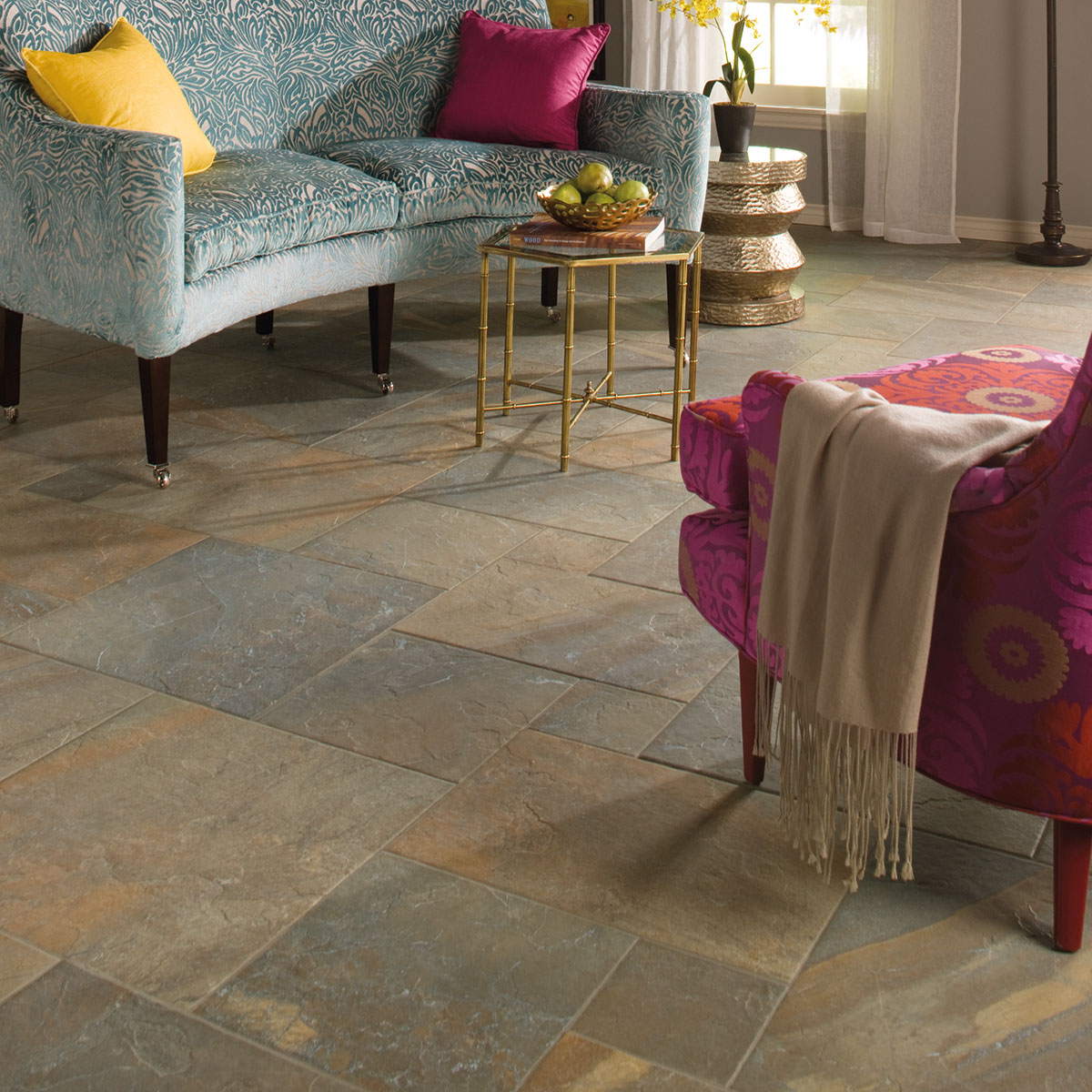
Porcelain and ceramic tile look similar at a distance and are often used interchangeably in conversation.
But they perform differently, cost differently, and suit different applications.
The Short Answer
Porcelain for floors, ceramic for walls. That covers the large majority of residential decisions in Ontario and it is the approach we use as the starting point in almost every tile consultation.
The difference is not marketing. Porcelain is fired hotter from finer clay, comes out denser, and absorbs 0.5 percent or less of its weight in water. Standard ceramic absorbs 3 to 7 percent. Everything else — hardness, cost, how it cuts, where it can go — follows from that one number. Ceramic is not a worse tile; it is a tile with a shorter list of appropriate places, and putting it on a wet floor is what turns a price saving into a problem.
How They Are Made, and Why It Settles Everything Else
Both are clay fired in a kiln. Porcelain uses a finer-grained clay, usually white, fired at roughly 1200 to 1400 degrees Celsius. Ceramic uses coarser clay, often red, fired cooler. The higher temperature and finer body vitrify the porcelain further, closing the pore structure, and that is the whole of the difference at the point of manufacture.
Water absorption is the specification that officially separates them, and it is the one worth memorising. Porcelain must test at 0.5 percent or below, which is effectively impervious — porcelain can sit in standing water without taking any up. Standard ceramic runs 3 to 7 percent. In an Ontario home that gap matters in two specific places: bathrooms, where the floor sees water regularly, and anywhere exposed to freeze-thaw cycling, where absorbed water expands inside the tile body and breaks it from the inside.
The Specifications Side by Side
| Porcelain | Ceramic | |
|---|---|---|
| Water absorption | 0.5% or less | 3% to 7% |
| Typical PEI hardness | 4 to 5 | 2 to 3 |
| Product cost per sq ft | $3 to $8 standard, $6 to $15+ premium | $2 to $5 |
| Cutting | Wet saw with a diamond blade | Score-and-snap cutter |
| Cut edge | Usually the same colour through | Often a contrasting base under the glaze |
| Best use | Floors, wet rooms, entries, outdoors | Walls, backsplashes, light-traffic floors |
Installed labour costs are close to identical for the two, so the price gap on the finished floor is narrower than the product-cost gap suggests. On a bathroom floor, the difference between ceramic and porcelain is usually a rounding error against the cost of the room. That is the context in which the ceramic saving should be judged.
Reading the PEI Hardness Rating
PEI measures surface wear resistance, and it is the second number to ask for after absorption. It runs one to five:
- PEI 1 — light residential, wall applications only
- PEI 2 to 3 — residential floors in low to moderate traffic
- PEI 4 to 5 — heavy residential and commercial use
Most porcelain rates 4 or 5. Most standard ceramic floor tile rates 2 or 3. For a floor expecting ordinary residential traffic, PEI 3 is the minimum worth accepting, and in a hallway, kitchen or entry we would not go below 4. PEI says nothing about water and absorption says nothing about wear, which is why both numbers have to be checked, because neither stands in for the other.
Where Porcelain Is the Right Answer
- Bathroom floors with a shower in active use — the single clearest case in the house. Best Tile for Bathrooms covers shower floors and walls, which have separate requirements.
- Kitchens — standing water, dropped pans, and traffic concentrated in a few square feet. See Best Tile for Kitchens.
- Mudrooms and entryways — salt, grit and meltwater every winter.
- Basement floors — below grade, where moisture arrives through the slab, not over the top of it. Best Flooring for Basements in Ontario starts with what has to happen underneath.
- Heavy-traffic main floors — halls and open plans that take the whole household.
- Outdoor and covered spaces — only with a freeze-thaw rating, which is not automatic just because a tile is porcelain.
Where Ceramic Earns Its Place
Ceramic is not a compromise product. It is a product with a narrower brief, and inside that brief it is the sensible buy:
- Walls — shower surrounds, backsplashes, accent walls. Nothing walks on a wall, so PEI is irrelevant and the cost saving is free.
- Powder rooms and low-moisture spaces — a floor that sees a damp mop and little else.
- Low-traffic floors where budget is the constraint — with the PEI rating checked, not assumed.
- Decorative bands and insets inside a larger porcelain floor, where the ceramic is a design element, not a wear surface.
Not sure which one the room in front of you needs? Book an in-store appointment and bring the room dimensions — the answer usually takes about five minutes once someone knows what the floor is doing.
How to Tell Them Apart in a Showroom
The label settles it: tile carrying Tile Council of North America certification as porcelain has been tested against the absorption standard. Where the label is missing or ambiguous, two physical checks get you most of the way:
- Look at the cut edge. Porcelain is usually the same colour through its thickness, so the edge matches the face. Ceramic commonly shows a different-coloured body beneath the surface glaze.
- Pick up the box. Porcelain is noticeably heavier than ceramic of the same size. It is a crude test and it is surprisingly reliable.
Neither check is a substitute for the certification, and a tile sold as “porcelain look” or “porcelain style” is neither the material nor the standard. If the floor is going anywhere wet, ask for the absorption figure in writing.
Through-Body vs Glazed Porcelain
Once you are in porcelain there is a second choice, and it decides how the floor ages, not how it looks on day one. Through-body porcelain carries its colour and pattern the whole way through the tile, so a chipped edge shows the same colour as the surface and effectively disappears. Glazed porcelain wears a coloured glaze over a base body, so a chip exposes the base and reads as a white or grey mark against whatever the surface tone is.
Through-body is the choice for floors where edge damage is plausible — entries, kitchens, anywhere furniture gets dragged. Glazed is fine on walls and on floors that will not take impact. The premium for through-body is small relative to the cost of noticing a chip every day for fifteen years.
Cutting and Installation
Ceramic cuts with a score-and-snap cutter. Porcelain is hard enough to need a wet saw with a diamond blade, which is slower, wetter and dustier, and less forgiving of a mistake on an expensive tile.
For a professional crew this is a scheduling detail and nothing more. For anyone considering doing the work themselves, it is the difference between a manageable weekend and a job that needs equipment rental and a great deal of patience — and tile is already the least forgiving flooring to install badly. Tile Installation: What to Expect sets out what the work actually involves.
Choosing Between Them
- Establish what the surface is: floor or wall. A wall removes most of the argument in ceramic’s favour immediately.
- If it is a floor that will meet water, choose porcelain and stop deliberating.
- Check the PEI rating against the traffic, and treat 3 as the residential minimum and 4 as the sensible one.
- If the tile is going outside or anywhere that freezes, confirm a freeze-thaw rating in addition to the porcelain certification.
- For a porcelain floor that will take knocks, pay the small premium for through-body.
- Where the budget is genuinely tight, put the ceramic on the walls and keep the porcelain underfoot rather than the other way round.
Both materials sit inside a bigger decision about whether tile belongs in the room at all. Tile Flooring Guide for Ontario Homes covers format, finish, grout and cost, and Is Tile the Right Flooring for Your Home? takes the question a step further back.
Related Guides
A few other guides connected to this topic:
- Tile Flooring Guide for Ontario Homes: Porcelain, Ceramic, Stone & Where Each Works — The complete tile pillar.
- Tile vs Vinyl vs Hardwood: Choosing the Right Flooring by Room — Direct comparison with related materials.
- Tile Installation: What to Expect (Subfloor, Layout, Curing, Sealing) — Subfloor and underlayment considerations.
- Tile Floor Maintenance Guide: How to Clean Tile Floors and Keep Them Looking New — Closely related topic in this category.
- Grout Cleaning Guide: How to Clean Tile Grout (and When to Hire a Pro) — Closely related topic in this category.
Want Help Comparing Porcelain and Ceramic for Your Project?
The best way to choose what’s right for your home is to see the options side by side. Book an in-store appointment at one of our 17 Ontario showrooms and one of our consultants will walk you through what fits your space, your needs, and your budget – or request an in-home visit if that’s easier.
Frequently Asked Questions
Is porcelain better than ceramic?
Porcelain is denser, more water-resistant, and more durable—better for floors and wet areas. Ceramic works well for walls and lower-traffic, lower-moisture floors at a lower price.
How can I tell porcelain from ceramic?
Porcelain certification is the official indicator. Visually, porcelain often has uniform colour throughout the tile thickness; ceramic shows a different colour at the cut edge.
Is porcelain worth the extra cost?
For floors, especially in wet areas, yes—the durability and water resistance justify the price difference.
Can ceramic tile be used on bathroom floors?
Standard ceramic is generally not recommended for bathroom floors due to lower water resistance. Porcelain is the appropriate choice for bathroom floor applications.
Can You Mix Porcelain and Ceramic in the Same Bathroom?
Yes—it is a common approach. Porcelain on the floor (where slip resistance and water absorption matter most) paired with ceramic on the walls (where weight and cost matter more) saves significantly on the project without sacrificing performance. Visual coordination between the two is the main design consideration.