
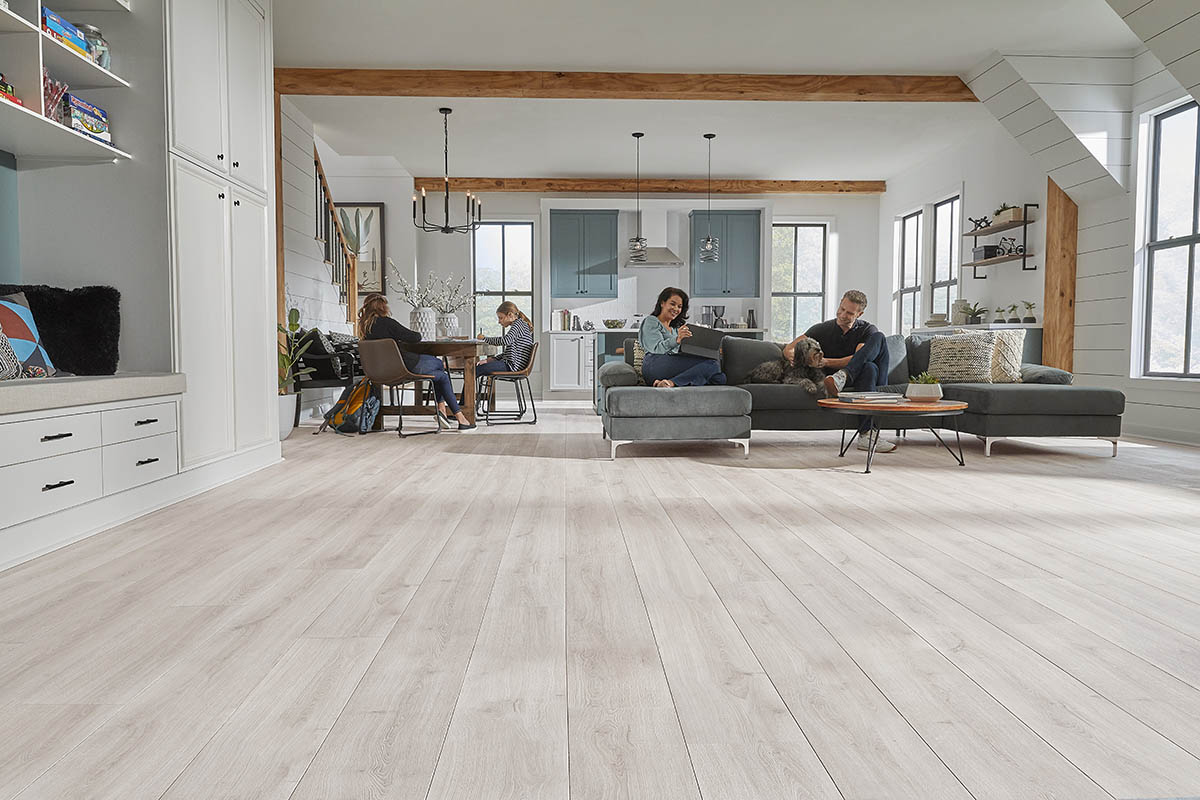
Laminate, vinyl plank, and engineered hardwood are the three flooring categories that compete most directly in mid-range Ontario homes. The three products produce similar visual results (wood-look floating-floor installations) through different constructions, and the practical differences between them affect which is appropriate for which rooms. Understanding the genuine differences helps homeowners make decisions that work over the long term.
This guide walks through how the three categories actually compare across the dimensions that matter and helps you understand which fits which situation.
The Short Answer
Vinyl where there is water, engineered hardwood where the room is on show and you are staying, laminate where you want a hard, scratch-resistant wood look and the budget matters. All three produce a wood-look floating floor and all three are legitimate; the question is which room, not which product.
The single most useful thing to know before comparing them is that laminate has the hardest surface of the three and the weakest core. That one fact explains nearly every trade-off below. The laminate pillar, the vinyl pillar and the hardwood pillar each go deeper on their own category.
How the Three Are Built
Laminate is a high-density fibreboard core carrying a printed photo-realistic surface under a melamine wear layer reinforced with aluminum oxide. Vinyl plank is fully synthetic — a flexible LVP or rigid SPC or WPC core, printed surface, clear wear layer, no wood anywhere in it. Engineered hardwood is a real hardwood wear layer bonded to a multi-layer plywood substrate, which is genuine wood on top of something dimensionally stable enough to go where solid wood cannot.
Each construction is optimised for something different, and the priorities are visible in the products. Laminate is built to deliver a wood look at high surface hardness for the least money. Vinyl is built for moisture tolerance and to go anywhere. Engineered hardwood is built to be real wood in rooms — including over concrete — where solid hardwood would fail. Solid vs Engineered Hardwood covers that last distinction properly.
The Comparison in One Table
| Laminate | Vinyl plank | Engineered hardwood | |
|---|---|---|---|
| Surface | Printed, aluminum-oxide wear layer | Printed, clear wear layer | Real wood |
| Scratch and dent resistance | Hardest of the three | Good; 30-mil wear layers approach laminate | Softest — it is wood |
| Water | Weakest — HDF core swells | Essentially waterproof | Handles incidental, not standing |
| Feel underfoot | Firmest | Firm, slightly cool | Slight give, warmest |
| Sound | Loudest — the characteristic click | Quiet with good underlay | Warmest acoustic |
| Refinishing | None | None | 1 to 3 times |
On visual authenticity the ordering is less clean than it looks. Engineered hardwood wins because the grain is real and the variation between boards is actual variation rather than a repeating set of printed designs. But premium laminate with embossing-in-register and high-resolution printing is convincing at normal viewing distance, and high-end vinyl has closed most of the gap in the last few years. At close inspection both printed surfaces give themselves away. In a formal room where the floor is part of the design, that matters. In a family room, it does not.
Where Each One Wins
Laminate: Surface Hardness
Nothing in this comparison resists a dragged chair leg or a dropped can better than an aluminum-oxide wear layer at AC4 or AC5. In a household where the floor’s enemy is scratching rather than water, laminate is not the budget compromise — it is the technically correct answer, and it happens to cost less. Its limit is absolute and worth repeating: the core is wood fibre, and even waterproof grades have real boundaries.
Vinyl: Water, and Everywhere Else
For wet rooms and anything below grade, vinyl is not a preference, it is the answer. It is also the most forgiving of the three about what it will go over. The trade is a softer surface that shows heavy impacts more readily and a look that, at the entry level, is the least convincing of the three.
Engineered Hardwood: Time
Its surface is the softest here and it still outlasts both alternatives, because it is the only one that can be brought back. Refinished once or twice, engineered hardwood reaches 25 to 50 years while vinyl runs 15 to 25 and laminate 10 to 20. If you intend to be in the house for decades, that is the whole argument and it is a strong one.
Cost, and Cost Per Year
Across our own sales, laminate installs at $4.50 to $9.50 per square foot, vinyl plank at $4 to $13.50, and hardwood at $5.50 to $19.50. The middles are closer together than the spans suggest: most laminate projects land at $6 to $7, most vinyl at $6 to $9, and most hardwood at $7.50 to $11.50. The overlap is the interesting part, because spending at the top of one category frequently buys the bottom of the next one instead.
These three look almost identical in a photograph and feel completely different underfoot. Book an in-store appointment and walk on all three in the same visit — it settles the question faster than any comparison chart.
Divide by lifespan and the gap almost disappears. Run it on the bands where most projects actually land. Engineered hardwood at $7.50 to $11.50 over thirty years is $0.25 to $0.38 per square foot per year. Vinyl at $6 to $9 over twenty years is $0.30 to $0.45. Laminate at $6 to $7 over fifteen years is $0.40 to $0.47. On that arithmetic the three are within pennies of each other, and the working lives in the sum are what we would expect, and nobody has measured them, and the real decision is not value at all — it is whether you would rather pay less now or less over time. The laminate cost guide breaks the preparation and removal costs out separately, and those move a quote further than the category choice does.
Resale Value
Real wood is the only one of the three that shows up in an Ontario listing. Agents write hardwood into the description; nobody writes laminate into it. Homes with engineered hardwood on the main-floor public rooms photograph better and tend to move with less negotiation, and buyers in the mid and upper market do notice.
Whether that premium repays the cost premium is a different question, and often it does not. If you are staying fifteen years, the resale argument is close to irrelevant — buy the floor you want to live on. If you might sell within ten, it is worth putting engineered hardwood in the rooms a buyer walks through first, and laminate or vinyl everywhere else.
Most Homes Should Use More Than One
The framing of this comparison as a single choice is the mistake underneath most of the questions we get asked about it. Four things decide each room: its moisture conditions, its traffic, how long you plan to keep the floor, and how much the real-wood question matters to you in that particular space. Those four answers are rarely the same in a basement and a dining room.
What that produces in practice is a house running engineered hardwood through the main-floor public rooms, vinyl in the basement and the bathrooms, and laminate through bedrooms, hallways or a busy kitchen — with transitions handled properly where they meet. It is not a compromise; it is the arrangement that gets the most out of each product. The one arrangement that reliably disappoints is insisting on a single material everywhere and then accepting it in the one room where it does not belong. Vinyl vs Laminate Flooring narrows the field to two if hardwood is already ruled out.
One practical note on mixing them. Where two of these meet at a doorway, the height difference is usually 2 to 4 mm, which a reducer handles invisibly if it is planned and looks like an afterthought if it is not. Buying the three floors from one supplier is the easiest way to have that detail decided before anyone starts, rather than negotiated between two trades on the day. Our installation service covers the whole plan in one quote.
Related Guides
A few other guides connected to this topic:
- Laminate Flooring Guide for Ontario Homes (AC Ratings, Cores, Finishes & Where It Works) — The complete laminate flooring pillar.
- Water-Resistant vs Waterproof Laminate: What Is the Real Difference? — Direct comparison with related materials.
- Laminate Underlayment: When You Need It and What to Choose — Closely related topic in this category.
- Vinyl vs Laminate Flooring: What’s the Difference and Which Should You Choose? — Direct comparison with related materials.
- Vinyl & Laminate Floor Cleaning Guide: How to Clean Floors Without Causing Damage — Closely related topic in this category.
- Vinyl vs Laminate vs Engineered Hardwood: Cost, Durability & Where Each Works Best — Direct comparison with related materials.
- Flooring Installation Services — Our sell-and-install service — measuring, an itemized quote, and certified installation handled as part of your purchase.
- Why Work With Alexanian — A century of flooring and rug expertise, sell-and-install accountability, and full-service care.
Want Help Comparing These Three Flooring Types?
The best way to choose what’s right for your home is to see the options side by side. Book an in-store appointment at one of our 17 Ontario showrooms and one of our consultants will walk you through what fits your space, your needs, and your budget – or request an in-home visit if that’s easier.
Frequently Asked Questions
Is laminate better than vinyl?
Depends on the room. Laminate is more scratch-resistant; vinyl is more moisture-tolerant. Choose based on which matters more for the specific space.
Does laminate look as good as engineered hardwood?
Premium laminate with embossed-in-register texture looks very convincing. Engineered hardwood is more authentic because it is real wood.
Which is most durable?
Premium laminate at AC5 is typically the most scratch-resistant. Engineered hardwood lasts longest overall due to refinishing potential.
Which has the best resale value?
Engineered hardwood adds the most resale value, particularly in higher-value markets. Vinyl plank and laminate are increasingly accepted but do not match hardwood’s resale impact.