
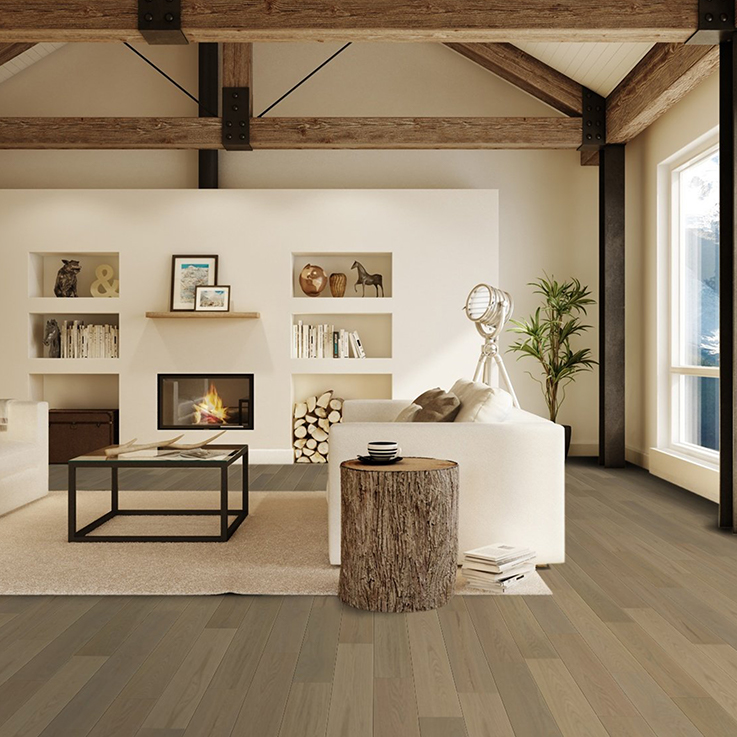
The single most important hardwood decision is solid versus engineered.
It affects where the floor can be installed, how it handles humidity, how many times it can be refinished, and how much it costs.
This guide walks through both, helps you understand the trade-offs, and provides a framework for choosing.
The Short Answer
Neither construction is better than the other, and the framing that treats engineered as budget hardwood is simply wrong. Solid is a single piece of wood, typically 3/4 inch thick. Engineered is a real hardwood wear layer bonded to a multi-layer plywood core. From above the two are identical, and nobody has ever walked into a room and identified which one they were standing on.
What decides it is the subfloor, the grade, and whether the house can hold a humidity range. Plywood, on or above grade, with humidity under control, and solid is the stronger long-term buy at 4 to 6 refinishings and a 50-to-100-year life. Concrete, below grade, a condo, or no active humidification, and engineered is correct on its own merits — a floated floor over a slab cannot be done in solid at any price.
On engineered, one specification carries most of the difference, and it does not buy what the industry says it buys. A wear layer buys refinishes, not years. Under 2 mm cannot be sanded at all; 3 to 4 mm takes two passes; above 4 mm, three or more. A chart that converts millimetres into a lifespan is a marketing document, and the numbers on it move every time you ask.
How Solid Hardwood Is Different From Engineered
Solid hardwood is a single piece of wood, typically 3/4 inch thick, milled to standard widths and finished either at the factory or after installation. Engineered hardwood is a layered product — a top wear layer of real hardwood bonded to a multi-layer plywood or HDF core, with total thickness ranging from about 3/8 inch to 3/4 inch.
From above, the two are identical. Both are real hardwood at the surface, and nobody has ever walked into a room and identified which one they were standing on. The differences are structural, and they show up in three places: where the floor can be installed, how it handles an Ontario humidity swing, and how many times it can be brought back with a sander.
How the Two Perform, Side by Side
| Solid Hardwood | Engineered Hardwood | |
|---|---|---|
| Dimensional stability | Expands and contracts more with humidity | Layered construction resists humidity-driven movement |
| Where it can go | On or above grade only — never over concrete or below grade | On, above or below grade; works over concrete with moisture management |
| Needs humidity control? | Yes | Performs reliably without active humidity control |
| Refinishing | Typically 4 to 6 times over its life | Set by wear layer — none under 2 mm, three or more above 4 mm |
| Lifespan we would expect | 50 to 100 years, refinished several times | Decades — set by the finish, not the wear layer |
| Installation | Nailed or stapled to plywood | Nailed, glued or floated |
| Installed, per sq ft | $5.50 to $19.50; most projects $7.50 to $11.50 | The same range, and the same rate to lay it — engineered is usually the cheaper wood, never the cheaper installation |
The cost gap is narrower than the table suggests, and at the top of the range it disappears entirely. Wide-plank engineered hardwood with a thick wear layer can match or exceed mid-range solid hardwood on price. Anyone treating engineered as the budget option is comparing the cheapest engineered against mid-range solid, which is not the same comparison.
Engineered hardwood’s installation flexibility is a large part of why it works in more situations than solid. A floated engineered floor over a concrete condo slab is a job that simply cannot be done in solid hardwood at any price, and how the floor is fixed down is decided at the same moment the product is.
What a Wear Layer Actually Buys You
If you compare only one number across engineered products, compare this one — then be careful about what you conclude from it. It drives most of the price difference, and it is the spec most likely to be missing from a showroom tag. What it does not drive is how long the floor lasts.
| Wear layer | Tier | Refinishes it supports | What happens at the end of them |
|---|---|---|---|
| Under 2 mm | Low-end | None — a sanding reaches the substrate | Surface repair and board replacement only |
| 2 to 3 mm | Entry to mid | One | One full reset of the finish |
| 3 to 4 mm | Standard for quality engineered | Two | Two resets, decades apart |
| Over 4 mm | Premium | Three or more | Refinishing stops being the constraint |
The number that makes that table true is the sanding itself. A professional floor sander takes 1 to 2 mm of wood off on each pass. Divide the wear layer by that and you have the refinish count, which is also why 2 mm is the floor below which nobody can help you: the first sanding would go straight through into the plywood.
A wear-layer figure on a showroom tag tells you how many refinishes are in the floor and nothing at all about the room it is going into. Bring the details of your subfloor to a showroom and a consultant will tell you which construction that room can actually take — in-home visits on request.
What the table deliberately has no column for is lifespan. The industry publishes one, and our own hard-surface buyer will not stand behind it. His words, and we are printing them because very few flooring retailers will: there is not a hardwood floor installed anywhere on the planet where the wood layer has been worn through by footsteps. Feet do not wear out wood, at any thickness. What fails is the urethane finish sitting on top of it — and refinishing is how a finish gets replaced, which is the entire reason the refinish count is worth knowing and the millimetre count on its own is not.
There is a floor on our own showroom racks that settles it. SBS Antique Perspectives has a 1.5 mm wear layer and a manufacturer’s 35-year warranty against finish wear-through. On a years-by-thickness chart that floor is written off inside a decade. The company that makes it warrants the finish for thirty-five years, and a customer holding the sample can read both numbers. That is why the chart is not on this page.
Where Each One Belongs
Solid hardwood is the stronger choice in:
- Main-floor rooms with active humidity management — the condition that makes everything else about solid work.
- Bedrooms on plywood subfloors, where carpet is not preferred.
- Homes planning multiple refinishing cycles and prioritising the longest possible flooring lifespan.
- Heritage and traditional homes, where solid hardwood’s history is part of the design argument.
Engineered hardwood is the stronger choice in:
- Installations over concrete — slab main floors, condos, and basements with proper moisture management.
- Homes without active humidity control, or in highly variable conditions.
- Wide-plank installations of 7 inches and up, where the layered construction resists the cupping and gapping wide solid planks can show.
- Modern homes where the visual difference is undetectable and the practical benefits are not.
Both are real hardwood and both produce beautiful, durable floors. The right choice depends on the house, not on which product is inherently better — and in most Ontario homes the subfloor has already made the decision before anyone looks at a sample.
What This Choice Does Not Decide
Solid versus engineered gets treated as the decision that settles everything else, and it does not. Species, plank width and finish are all separate choices, and both constructions are available across the full range of each. You can have white oak in either. You can have a 7-inch plank in either, though the engineered version will behave better. You can have a matte oil finish or a UV-cured factory finish on either.
So it is worth taking this decision on its own terms — subfloor, grade, humidity, how long you intend to keep the floor — and then choosing species, width and finish afterwards, rather than falling for a sample board and working backwards to justify it. The hardwood flooring guide for Ontario homes sets out the full order these decisions are best made in.
Related Guides
A few other guides connected to this topic:
- Hardwood Flooring Guide for Ontario Homes (Solid, Engineered, Species, Finishes) — The complete hardwood pillar.
- Hardwood vs Engineered vs Vinyl Plank: Cost, Look & Long-Term Performance Compared — Direct comparison with related materials.
- Wide Plank vs Narrow Plank Hardwood: Style, Performance & Cost — Direct comparison with related materials.
- Hardwood Floor Maintenance Guide: How to Clean and Protect Hardwood Floors Over Time — Closely related topic in this category.
- Laminate vs Vinyl Plank vs Engineered Hardwood: Which Should You Choose? — Direct comparison with related materials.
- Vinyl vs Laminate vs Engineered Hardwood: Cost, Durability & Where Each Works Best — Direct comparison with related materials.
- Flooring Installation Services — Our sell-and-install service — measuring, an itemized quote, and certified installation handled as part of your purchase.
- Why Work With Alexanian — A century of flooring and 17 Ontario showrooms behind every recommendation.
Not Sure Whether Solid or Engineered Hardwood Is Right for You?
The best way to choose what’s right for your home is to see the options side by side. Book an in-store appointment at one of our 17 Ontario showrooms and one of our consultants will walk you through what fits your space, your needs, and your budget – or request an in-home visit if that’s easier.
Frequently Asked Questions
Is solid hardwood always better than engineered?
No—engineered hardwood is the better choice in many situations, particularly over concrete, in homes without active humidity management, and for wide-plank installations.
Can engineered hardwood be refinished?
It depends on wear-layer thickness, because a sanding removes 1 to 2 mm. Under 2 mm cannot be sanded at all; 2 to 3 mm gives one refinish, 3 to 4 mm gives two, and above 4 mm gives three or more.
Which lasts longer: solid or engineered?
Solid lasts longer, and the reason is refinishing rather than the wood itself: at 4 to 6 sandings over its life we would expect 50 to 100 years from a solid floor that is kept at a sane humidity. Engineered has fewer resets available, so the number depends on how many the wear layer allows — not on the thickness converting into years directly.
Is engineered hardwood real wood?
Yes — the top wear layer is real hardwood. The layered construction underneath is what differs from solid. Visually and underfoot the two are essentially identical; the difference shows up in installation flexibility, dimensional stability and refinishing potential.
Can engineered hardwood be used in bathrooms?
Engineered hardwood is more moisture-tolerant than solid hardwood but is not waterproof. Powder rooms and lower-moisture bathrooms can sometimes work with engineered hardwood and careful spill management. Full bathrooms with active showers are not recommended—the constant humidity creates conditions even engineered hardwood struggles with over time.