
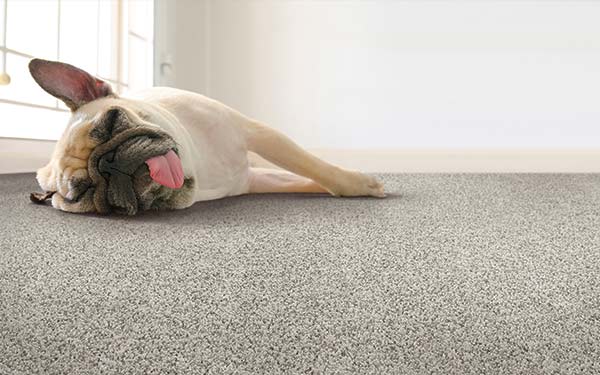
Pets and carpet have a long, complicated history in residential homes.
Modern carpet has caught up to pet ownership in ways older carpet never could. Solution-dyed fibres handle accidents that would have ruined carpet a decade ago. Tighter constructions resist claw damage. Better backings keep moisture away from the subfloor.
Choosing well still comes down to specifics, and the specifics are not the ones most people expect. The fibre matters less than how the colour was put into it, and the pad matters more than almost anything above it.
The Short Answer
Solution-dyed nylon or solution-dyed polyester, in a cut pile or a tight low loop, over a moisture-barrier pad. That combination is the reliable answer, and each part of it is doing a specific job: solution-dyed colour survives the harsh cleaners an accident calls for, a cut pile gives a claw nothing to catch, and the barrier pad decides whether an accident is a cleaning job or a replacement job.
Avoid large-loop Berber in a home with cats. A single caught claw can run a loop along the carpet, and that is damage no cleaning addresses.
Match the carpet colour to the coat, not to the room. A medium beige or tan hides yellow lab hair; a deeper brown or grey hides black or grey hair. Pattern and multi-tonal colour hide accidents and traffic marks that solids show plainly. Pure white and pure black both show everything.
What Makes Carpet Pet-Friendly
Three properties matter most: stain resistance, durability under claws and traffic, and ease of cleaning.
Stain resistance comes from fibre type and from how the colour is applied to it. Durability comes from fibre, density and construction. Ease of cleaning comes from fibre, pile style and underpad. The three overlap. A pet-friendly carpet is a set of decisions that agree with each other, not a single product category.
Getting all three right means carpet that holds up to pet life without becoming a maintenance burden. Getting one wrong usually shows within two years, and it shows in the same place every time: the route the animal takes across the room. The full carpet buying guide works through the same four decisions for a household without pets in it.
Best Fibres for Pet Households
Solution-dyed polyester or nylon is the standard recommendation for pet households. The colour is locked into the fibre during manufacturing, which means even harsh cleaners and bleach-based stain treatments do not affect the carpet’s appearance.
That property is worth more here than anywhere else in the house, because pet accidents are the one household stain where the correct response is an aggressive one. A carpet whose colour sits on the surface of the fibre forces a choice between cleaning the stain properly and keeping the colour. A solution-dyed carpet removes the choice.
Between the two, nylon recovers from compression better and suits a household where the animal is large, active, or sharing a busy main floor. Polyester is softer and costs less, and it holds up well where the traffic is moderate. Wool needs thinking about: it is naturally stain-resistant through its lanolin coating and more vulnerable to acidic stains than the synthetics, which is exactly the category a pet accident falls into.
Why Pile Style Matters for Pet Households
Cut-pile carpets are the safer choice for homes with cats and dogs.
Loop pile, and Berber especially, can snag on claws. A single caught loop can run along the carpet and unravel quickly, which is a different category of problem from wear: it happens in one moment, it is immediately visible, and no amount of cleaning or maintenance addresses it. Cats are often the bigger snag risk than dogs, because of how they use their claws on a textured surface.
If the look of loop pile is the priority, choose tight, low-loop constructions and avoid the larger Berber loops. Some premium loop products carry specific warranties against snagging from pets’ claws — select Tuftex constructions among them — and in a household with cats, ask for that warranty by name.
How Carpet Density Affects Pet Performance
Denser carpet hides pet hair, dander and traffic patterns better than low-density carpet.
It also resists matting along the routes pets use. The most visible pet wear in carpet is rarely from claws — it is the flattening that develops where an animal walks, sleeps or pivots regularly, and a dense carpet takes far longer to show it. Look for face weight above 40 ounces per square yard for pet households where possible.
Density also changes how much of the hair ends up in the carpet in the first place. A tightly packed surface gives hair less to work its way into, and routine vacuuming does more on a floor that is easier to keep.
Best Underpad for Pet Households
A moisture-barrier underpad is essential in homes with pets that may have accidents. It is the single decision on the quote that most affects what an accident eventually costs.
Without a moisture barrier, accidents soak through to the subfloor, where the smell and the bacteria become extremely difficult to remove. With a barrier, the accident stays on the carpet surface where it can be cleaned thoroughly. The difference is not one of degree: one version is a cleaning, the other is a section of floor coming up.
Many manufacturers now offer pet-specific pads combining a moisture barrier with odour-control treatment. Carpet Padding Guide: Why the Right Underpad Matters covers which specialty pads earn the upgrade and what density to pair them with.
Best Colours and Patterns for Pet Households
Carpet that matches the colour of pet hair is the most practical choice in the house. A medium beige or tan hides yellow lab hair; a deeper brown or grey hides black or grey hair.
Patterned carpets hide accidents and traffic patterns better than solid colours, and multi-tonal colours add visual depth while disguising the small inevitabilities of life with an animal. Pure white and pure black are both poor choices in a pet household — each extreme shows every speck of the opposite.
How to Clean Pet Accidents on Carpet
Speed is the most important factor. Address accidents within the first hour where possible.
- Blot, do not rub, with a clean white cloth to absorb as much as possible.
- Apply an enzyme-based pet cleaner formulated to break down urine.
- Let the cleaner work for as long as its directions specify, then blot clean.
- Check the same spot once it has dried, because a mark that has wicked back up from below will only show then.
For older or set-in accidents, professional carpet cleaning is usually the most effective answer. Annual professional cleaning is a sensible baseline for a pet household, and semi-annual makes sense in homes with several animals. If that is the position you are in, book a carpet cleaning before deciding anything about replacement.
Bring a photo of the dog. Book a showroom visit and a consultant will match the colour to the coat and the construction to the claws. We can also come to you.
How Pet Traffic Patterns Form (and How to Manage Them)
Most pet households develop visible traffic patterns within a few years, along the routes pets take from sleeping spots to food bowls, doors, or a favourite window.
Predictable routes are manageable routes. A washable runner or area rug laid along the most-used path can be cleaned or replaced as it wears while the carpet underneath stays as it was. It is a cheaper thing to replace than a room of carpet, and replacing it takes a decision and an afternoon.
When Pet Damage Means Replacement vs Cleaning
Most pet owners face this decision eventually, and understanding it in advance helps, because the answer is usually settled years earlier by what went under the carpet. Our consultants read it off three things: how far the liquid went, what the odour is doing, and what condition the fibre is in.
Surface stains, mild matting and general wear can usually be addressed through professional cleaning. The test is whether the damage has stayed above the backing. Carpet that looks tired, smells stale, or has taken a series of accidents that were cleaned promptly is, in most cases, a cleaning job — and cleaning is dramatically cheaper than replacement, so it is worth establishing that first.
Damage that has reached the underpad is a different situation. Soaked-through accidents, deep matting that does not recover after cleaning, and persistent odour all point the same way. The underpad is rarely cleanable; once it has absorbed damage, removing the smell means replacing the pad and usually the section of carpet above it. This is the point where a moisture-barrier pad pays for itself several times over, because it is the barrier that determines whether an accident ever reaches this stage.
Two practical signals help separate the cases. Persistent odour that survives a proper professional cleaning points at the pad underneath. And matting that does not lift after cleaning means the fibre has been permanently crushed, which no further cleaning reverses.
Replacement is the right call on either of two triggers — a single spot a pet keeps returning to, soaked through the primary backing into the padding and the floor; or persistent odour across more than one area. One saturated favourite spot is enough on its own, because the contamination underneath it is not reachable from above. How Long Does Carpet Last? covers the same decision for carpet that has simply reached the end of its life.
What to Put on the Quote in a Pet Household
| Decision | What to choose | Why |
|---|---|---|
| Fibre | Solution-dyed nylon or solution-dyed polyester | Colour is locked into the fibre during manufacturing, so even harsh and bleach-based stain treatments do not affect the carpet appearance |
| Pile style | Cut pile, or a tight low-loop construction | Loops can snag on claws and run along the carpet. Cats are often a bigger snag risk than dogs |
| Density | Face weight above 40 ounces per square yard where possible | Denser carpet hides hair and dander and resists the matting that forms along regular pet paths |
| Colour and pattern | Mid-tone matched to your pet coat colour, with some pattern variation | Hides hair, accidents and traffic patterns. Pure white and pure black show every speck of contrast |
| Underpad | Moisture-barrier pad, ideally with odour-control treatment | Keeps accidents on the carpet surface where they can be cleaned, rather than soaking through to the subfloor |
Related Guides
A few other guides connected to this topic:
- How to Choose the Right Carpet for Your Home in Ontario (Complete Guide) — The complete carpet pillar.
- Carpet Padding Guide: Why the Right Underpad Matters — The moisture-barrier decision, in full.
- Carpet Pile Types Explained: Loop, Cut, Frieze, Berber & Patterned — Which constructions claws can catch, and which they cannot.
- Best Carpet for Stairs: Durability, Safety & Installation — Where pets do the most concentrated damage.
- How Long Does Carpet Last? Lifespan, Warranties & When to Replace — Lifespan, replacement, and longevity details.
- Pet Stain & Odour Removal Guide: From Carpet, Rugs & Hard Surfaces — Dealing with the accident once it has happened.
- Carpet Cleaning Guide: How Often to Clean Your Carpet & When to Call a Pro — Cleaning frequency for a pet household.
- Floor, Carpet & Rug Care Guide: How to Clean and Protect Every Surface in Your Home — The complete cleaning and maintenance pillar.
Looking for Carpet That Will Actually Hold Up to Your Pets?
The best way to choose what’s right for your home is to see the options side by side. Book an in-store appointment at one of our 17 Ontario showrooms and one of our consultants will walk you through what fits your space, your needs, and your budget — or request an in-home visit if that’s easier.
Frequently Asked Questions
What is the most pet-friendly carpet?
Solution-dyed nylon in a cut-pile or tight low-loop construction, paired with a moisture-barrier underpad, is the most reliable pet-friendly combination.
Can dog or cat claws damage carpet?
Cut-pile carpet handles claws well; loop pile can be snagged, and a caught loop can run and unravel quickly. Avoid Berber and other large-loop styles in homes with cats. Tightly twisted frieze cut pile performs well and hides minor pulls. Trimming claws regularly reduces wear regardless of carpet type.
Is wool carpet good for homes with pets?
Wool can work but is less stain-resistant than solution-dyed synthetics. For homes with several pets or frequent accidents, synthetic fibres are the more practical choice.
How often should carpet be cleaned in a pet household?
Professional cleaning every 6 to 12 months suits most pet households, more frequently with several pets or shedding breeds.
How long does pet odour stay in carpet?
Surface accidents cleaned within 24 hours usually leave no lasting odour. Accidents that have soaked into the underpad almost always leave persistent odour that survives surface cleaning. The underpad usually needs replacement, and sometimes the affected carpet section with it. Annual professional cleaning combined with prompt accident response keeps most pet households odour-free.