
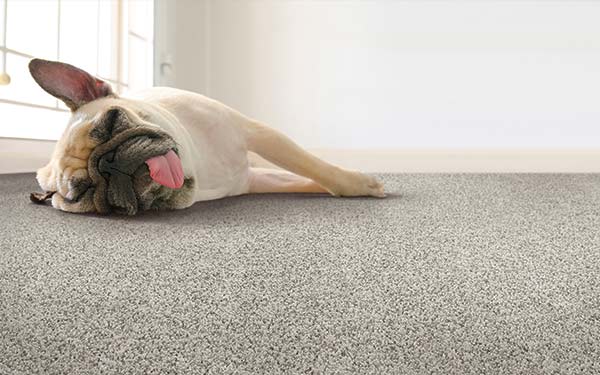
Pet accidents are part of life with cats and dogs. Whether the pet is house-training, aging, sick, or just had an unexpected moment, knowing how to address stains and odours quickly determines whether the issue becomes a permanent problem or fades into the kind of minor incident every pet household experiences occasionally.
Different surfaces and different types of accidents need different approaches. The right approach catches the issue while it’s still recoverable; the wrong approach lets a minor incident become permanent damage.
The Short Answer
Blot it out before you put anything on it, then saturate the area with an enzyme cleaner — wider than the visible mark — and let it sit for as long as the label says. Everything else is a variation on those two steps.
Household cleaners do not work here, and the reason is chemical, not a matter of strength. Urine leaves uric acid crystals that ordinary detergents cannot break down, so a spot can be cleaned to the eye and start smelling again the first humid day. Enzymes digest the crystals. Nothing else in the cupboard does.
The clock is the other half of it. Inside an hour, almost anything is recoverable. After a day, the crystals have set into the fibre. After a week you are into specialist treatment and the honest answer stops being a guarantee.
Why Pet Accidents Are Different From Other Spills
Pet urine in particular has properties that make it harder to clean than typical spills. It contains uric acid that crystallizes into fibres or surfaces and continues to release odour even after surface cleaning. It penetrates deeper than water-based spills because of its volume and composition. Bacteria from urine continue producing odour over time even after the visible accident is cleaned. And pets often return to scent-marked spots, which means an incompletely cleaned accident invites repeat incidents.
The last of those gets underestimated. An incompletely cleaned accident is not a neutral outcome — it is a scent marker, and it tells the animal that this is where to go next time.
The Response Clock
| Time since the accident | What is still possible |
|---|---|
| Within the first hour | Full clean-up, no lasting stain or odour |
| Within 24 hours | Most stains and odours still come out, with more work than a fresh one takes |
| After 24 hours | Uric acid has crystallised into the fibre. Specialised cleaners needed; some odour or staining may stay |
| After a week | Deep treatment, and permanent staining or odour becomes a real possibility |
Speed matters more for pet accidents than for almost any other spill. Within the first hour, full clean-up is possible without lasting odour or stain. Within the first twenty-four hours, most stains and odours can still be addressed, though more thoroughly than fresh accidents require. Beyond twenty-four hours, urine has crystallized into fibres or surfaces, and specialized cleaners are needed; some odour or staining may persist despite best efforts. Beyond a week, deep treatment is often required, and permanent staining or odour becomes possible.
The first hour is the highest-leverage window in pet stain response, and it’s worth treating accidents seriously the moment they happen, before you finish what you were doing.
Treating a Pet Stain on Carpet
Three steps, in this order, and the order is the part that matters.
- Blot before anything else. Clean white cloths or paper towel, pressed firmly and not rubbed — rubbing spreads the accident sideways and drives it down. Change cloths as they saturate, and get as much liquid out as you can before any product goes on.
- Saturate with an enzyme cleaner. Generously, and past the edge of what you can see, because urine spreads underneath further than it shows on top. Then leave it alone for the dwell time on the label, usually 10 to 30 minutes. The dwell is the treatment; cutting it short is the most common reason this fails.
- Blot again and let it dry completely. Weight a pad of cloths down over the spot for a few hours to draw moisture back up. Air dry fully before the area goes back into use, and do not vacuum it until it is dry.
When the Underpad and Subfloor Are Affected
Older accidents have often soaked through carpet to the underpad and sometimes to the subfloor underneath. Surface cleaning won’t address odour from saturated underpad—the smell continues even after the carpet appears clean to the eye. Confirming whether the underpad is affected means lifting the carpet, which should be done by a professional if you’re not comfortable with the process.
Affected underpad usually needs replacement; cleaning rarely restores it fully. Affected subfloor needs to be sealed with a stain-blocking primer to prevent odour from continuing to release. For chronic or severe pet odour issues, this deeper investigation is often necessary even when surface cleaning seems to have worked.
Treating Pet Stains on Hardwood
Hardwood pet accidents have specific challenges that depend on how quickly they’re addressed. Surface stains caught immediately can be blotted and cleaned with hardwood-safe cleaner, and most fresh accidents leave no lasting damage if addressed quickly. Penetrated stains—urine that has soaked into the wood and shows as dark spots—often require sanding and refinishing of the affected boards because the discoloration goes below the finish into the wood itself. Severe damage to boards beyond what refinishing can address means replacing boards.
Hardwood floor maintenance covers the daily care that keeps a finish intact enough to buy you the time to react.
Treating Pet Stains on Vinyl, Laminate, and Tile
Hard surface flooring is generally more forgiving of pet accidents than carpet or hardwood. Vinyl plank handles surface accidents that clean up easily, though standing accidents at seams should be addressed quickly to prevent moisture infiltration. Laminate handles surface accidents but standing accidents need prompt attention because moisture at edges causes swelling. Tile cleans with an appropriate cleaner, though the grout is the part that holds odour — enzyme cleaner worked into the joints deals with what surface cleaning misses, and grout cleaning covers the case where it has been going on long enough to have soaked in.
All hard surfaces benefit from prompt attention but rarely sustain permanent damage from individual accidents addressed quickly.
Pet accidents beyond DIY? Book in-home carpet steam cleaning — and ask about green rug washing for affected area rugs.
Treating Pet Stains on Area Rugs
Area rugs respond well to specialized treatment, and they have an advantage that wall-to-wall carpet doesn’t: they can be moved. Smaller rugs can go to the plant for in-plant washing—a green, no-harsh-chemical power-wash that is safe for wool and natural fibres—if accidents are recurring. Larger rugs benefit from blotting, applying enzyme cleaner, allowing it to work, and then having professional cleaning done in place.
Wool and natural fibre rugs need wool-safe enzyme cleaners specifically. Standard pet cleaners can damage wool. For valuable rugs with pet damage, professional rug washing produces dramatically better results than home treatment. The Area Rug Cleaning & Washing Guide covers professional rug cleaning options in more depth.
Eliminating Persistent Odour
Some pet odour issues persist even after treatment, and several escalation steps can help. Use a UV blacklight to identify all affected areas—urine glows under UV, and many homeowners discover affected areas they didn’t know existed. Apply enzyme cleaner to all identified spots, allowing the full recommended time to work. Consider professional cleaning by a pet-stain specialist for severe cases.
If carpet underpad is involved, replacement may be necessary. If the subfloor is involved, sealing with a stain-blocking primer addresses odour at the source. For severe cases with whole-room odour, ozone treatment by a professional remediation service can address airborne contamination that other methods can’t reach.
When the Mark Comes Back a Week Later
A spot that reappears days after a clean has three separate explanations. They need different responses, so it is worth knowing which one you are looking at instead of cleaning the same patch again and hoping.
- Wicking. The accident soaked through to the backing and into the cushion below. As the carpet dries, what is down there travels back up the fibres to the surface, attracts soil, and shows again as a discoloured area. Repeated cleanings are sometimes simply what it takes.
- Residual detergent. Cleaning solution left in the pile attracts soil to exactly the spot that was cleaned. A badly rinsed patch gets dirty faster than the carpet around it. Using solutions sparingly, and blotting instead of scrubbing, is the prevention.
- A contaminated underpad. The one that means replacement of the pad instead of another clean.
The reason to separate them is that the first two are cleaning problems and the third is not. Ask which one you are being told it is.
Preventing the Damage in the First Place
Four things change how much an accident costs, and the first one is decided before the carpet is ever laid.
- Moisture-barrier underpad in a pet household — it is the difference between a spot on the carpet and a problem in the subfloor, and it should be specified on any new carpet going into a home with animals
- React the same day — almost all the damage happens after the accident and not during it
- Keep an enzyme cleaner in the house, not on a shopping list
- Professional cleaning every six to twelve months in an active pet household, which keeps the general soil load down so the accidents are the only thing being dealt with
When to Replace Rather Than Clean
Before any of the detail below, there is a test you can run in ten seconds and it decides most of these cases. Leave the room for a minute and walk back in. An odour you notice only when you are close to the carpet, or only on a humid day, is a cleaning problem. An odour that meets you at the door is off-gassing from below the carpet, and that is a replacement.
Some pet damage is beyond cleaning. Carpet with widespread underpad damage and persistent odour despite enzyme treatment may need replacement. Hardwood with deeply penetrated urine stains across multiple boards typically warrants replacement of those boards instead of further attempts at restoration. Rugs with damage spread throughout, where nothing is confined to spots, often aren’t worth restoring. Subfloor with persistent contamination that can’t be sealed may need replacement.
In these cases, replacement with proper moisture-management measures for new flooring often produces better outcomes than continued attempts to clean what’s accumulated past the point of restoration.
Responding to Pet Accidents
- Keep enzyme cleaner on hand for immediate response
- Address accidents within the first hour where possible
- Use a UV blacklight to find contamination you did not know about
- Schedule professional cleaning at appropriate intervals for a pet household
- Consider whole-system improvements such as moisture-barrier pad and a sealed subfloor at the next flooring renovation
Pet accidents are the sharp end of a routine that runs across every surface in the house — the whole-home care guide covers the rest of it.
Related Guides
A few other guides connected to this topic:
- Floor, Carpet & Rug Care Guide: How to Clean and Protect Every Surface in Your Home — The complete cleaning and maintenance pillar.
- Steam Cleaning vs Dry Cleaning Carpet (Which Is Better?) — Direct comparison with related materials.
- Carpet Cleaning Guide: How Often to Clean Your Carpet & When to Call a Pro — Closely related topic in this category.
- Best Carpet for Pets: Stain Resistance, Durability & Easy Cleaning — Closely related topic in this category.
- How to Choose the Right Carpet for Your Home in Ontario (Complete Guide) — The complete carpet pillar.
- How Long Does Carpet Last? Lifespan, Warranties & When to Replace — Lifespan, replacement, and longevity details.
- How to Choose the Right Flooring for Your Home in Ontario — Choosing floors that survive animals, before the accident happens.
- Why Alexanian — A century in the trade, and a cleaning arm that handles the aftermath.
Dealing With Pet Stains and Odours?
When your carpet needs more than routine care, book in-home carpet steam cleaning and our technicians handle the deep clean from start to finish. Where a rug is the casualty, it comes to the plant instead — pick-up from the home, or drop-off at any of our stores.
Frequently Asked Questions
How do I get pet urine smell out of carpet?
Use enzyme-based cleaners specifically formulated for pet accidents, not standard household cleaners. Apply generously to fully saturate affected area, allow to work for full recommended time, then blot dry.
Can pet urine damage hardwood floors?
Yes. Urine that soaks into wood causes dark stains that often require sanding and refinishing. Surface accidents addressed quickly typically leave no lasting damage.
Why does my carpet still smell after cleaning?
Often because the underpad has absorbed urine. Surface cleaning does not address contamination in the pad. Pad replacement may be necessary.
Are enzyme cleaners safe for all surfaces?
Enzyme cleaners are safe for most carpets, hard surfaces, and synthetic rugs. For wool rugs and natural fibre rugs, use only wool-safe enzyme cleaners specifically formulated for those materials.