
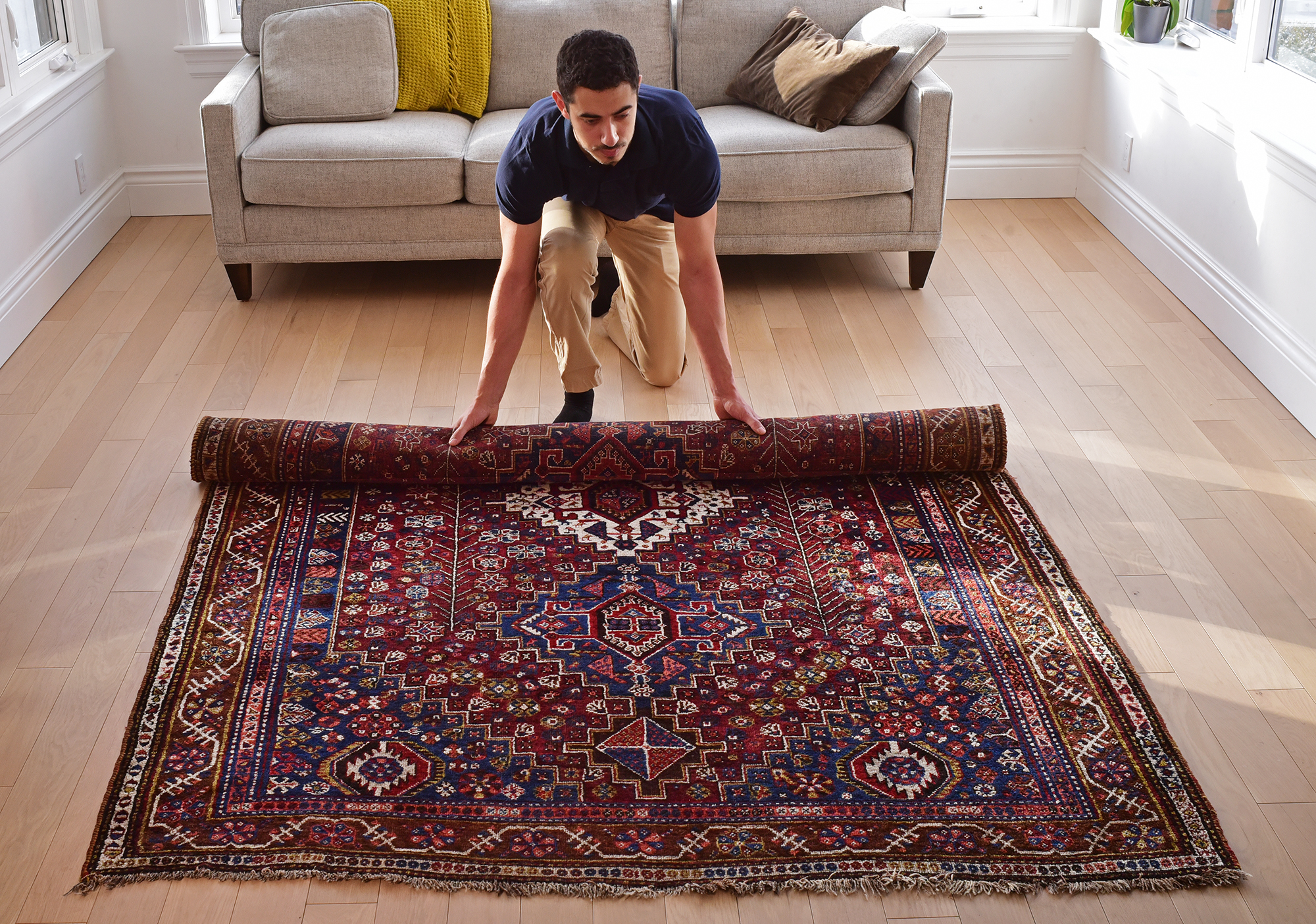
Rugs are almost never killed by an event. They are killed by grit — the sand, road salt and general debris walked in from outside, which works down through the pile and sits at the base acting as an abrasive between every footstep and the fibre.
That is why vacuuming is not tidying. It is the single maintenance habit that decides how long the rug lasts, and it does its most important work on dirt you cannot see. Everything else in this guide matters; nothing else matters as much.
The Short Answer
Vacuum lived-in rugs twice a week and bedrooms weekly. Blot spills within the hour, working inward, never rubbing. Rotate every three months. Send an Oriental or specialty rug out for a proper wash every two to four years — sooner for a hallway or a house with dogs, and straight away after an accident that soaked in.
The one thing worth unlearning: at home, gentler is better. Most rug damage we would call self-inflicted comes from treatments applied with good intentions and too much force — home steam cleaners, stiff brushes, bleach on a stain, hot water on a spill. The instinct to attack a mark harder is the instinct to resist.
Grit Is the Thing Actually Killing It
A rug is built to absorb a certain amount of wear, and it does that well until the grit arrives. Hard particles lodged at the base of the pile cut fibres every time weight comes down on them. Nothing about this is visible while it is happening. It becomes visible as a wear path, at which point the fibre is already severed and no amount of cleaning brings it back.
The other two slow killers work the same way. A spill left to dry bonds to the fibre and stops being a spill. Compression under a chair leg becomes permanent if the rug never moves. All three are cheap to prevent and effectively impossible to reverse. That is an unusual ratio, and the reason a fifteen-minute weekly habit is worth this much attention.
How Often to Vacuum
| Where the rug is | How often |
|---|---|
| Living room, family room, anywhere with daily traffic | Twice a week |
| Hallway, entry, stair landing | Twice a week |
| Bedroom | Once a week |
| Formal or spare room | Once a week, or when it starts to look like it wants it |
That table used to run higher, and it came down on the advice of our own plant — where the view is that expecting a household to vacuum more than once or twice a week is a stretch. It is a schedule somebody will actually keep, which is the only kind that does any good.
Pets put more into a pile than ordinary soil does, and hair binds into the pile base in a way grit does not. What they do not do is change what anyone will realistically keep up. So hold the twice-a-week habit in the rooms that get walked on, and expect the rug in a pet household to want sending out nearer the twelve-month end of its washing interval.
Wool
Suction, not agitation. Either use a vacuum with no beater bar, or raise the bar to its highest setting. Repeated hard beating breaks wool fibres over years, and it is the most common way a good wool rug is quietly shortened. Keep the beater bar off the fringe entirely — over enough passes a vacuum will eat a fringe, and on a hand-knotted rug the fringe is the foundation warp, so what you are wearing away is structural. A new wool rug will shed heavily for three to six months regardless of what you do; that is loose fibre from manufacture, it is normal, and vacuuming gets you through it faster.
Synthetics
Nylon, polyester and polypropylene all take standard vacuuming, beater bar included, set to the pile height. Go over the rug in more than one direction — the pile leans, and a single pass only cleans one face of each fibre. Which synthetic you have changes the cleaning latitude considerably; the fibre comparison sets out what each one tolerates.
High Pile and Shag
Suction only, or a carpet rake. A beater bar in a long pile pulls fibres out and does not clean them. These are also the rugs that most benefit from being taken outside and shaken, because debris sits far below where a vacuum head reaches.
The First Hour After a Spill
Whether a spill becomes a stain is decided in the first hour, and mostly in the first five minutes. The order matters:
- Blot with a clean white cloth. White, so no dye transfers into the rug.
- Do not rub. Rubbing drives the spill down into the base and spreads it sideways, turning a small problem into a large faint one.
- Work from the outside in. Coming in from the edge keeps the spill from growing.
- Cool water only. Hot water sets several common stains permanently — protein stains especially.
- Then, if needed, a rug-safe cleaner, tested somewhere it will not show first.
- Blot dry and let it dry fully before walking on it. Standing on a damp rug pushes what is left of the spill back into the base.
Nearly every fresh spill comes out completely. Nearly every stain was a spill that waited.
Treatment by Stain Type
| Stain | What to use | The thing that ruins it |
|---|---|---|
| Juice, soda, coffee, tea | Blot, cool water, rug-safe cleaner | Hot water |
| Food oil, makeup, grease | Weak dish-soap solution, blotted | Scrubbing; it spreads the oil |
| Pet accidents | Enzyme cleaner made for uric acid | Ordinary household cleaner — it masks the smell and leaves the source |
| Red wine | Blot hard immediately, then club soda or a wine-specific product | Waiting; and salt, which does very little |
| Mud and salt | Let it dry completely, then vacuum it out | Attacking it wet, which pushes it into the pile |
Test any cleaner on a hidden corner before it goes anywhere visible. Natural fibres and older rugs are the ones where a product will occasionally lift colour along with the stain. And there is a point at which escalating the home treatment does more harm than the mark did — on a set-in stain, stopping and sending it out is the cheaper decision.
Rotate It, and Actually Put It in the Calendar
Turn the rug every three months. That is our plant’s figure, and the reason it gives for it is the one that matters: at three months the wear and the pile distortion stay balanced. Two things otherwise become permanent — the wear path where people walk, and the fade line where sunlight falls — and a rug in front of a south-facing window wants turning more often still, because the fade differential builds faster than the wear does.
Rotation manages the fade. It does not stop it, and the thing that does is the window. Our consultants will say plainly that the right window covering protects a rug from fading better than any amount of turning it — worth knowing before a good wool rug goes into the brightest room in the house.
While the rug is up, look at it from both ends. Every pile rug has a light side and a dark side, because the pile all lies one way — on a hand-knotted rug that direction is set knot by knot as each one is tied and pulled down. Looking into the nap and looking with it give you two different colours from the same rug, and the difference can be considerable. It is worth deciding which one you want facing the door, and turning the rug a full one hundred and eighty degrees if the answer is the other one.
Rotation also moves the furniture off the same four spots. Compression under a chair leg for five unbroken years does not lift out; the same compression interrupted twice a year mostly does. This is the maintenance habit most likely to be skipped, because the rug looks perfectly fine at the moment you would have done it and the benefit only shows up years later. Put a date in the calendar.
Wrinkles, Curling and Buckling
Most creases come out. Lay the rug flat in sunlight for a few hours; reverse-roll it against the direction of the crease and leave it overnight; or weight the ridge with something heavy for a few days. Any of the three usually resolves a fresh wrinkle.
Chronic buckling is different, and it is almost always a pad problem, not a rug problem. A rug that keeps rippling is a rug sliding and resettling on a hard floor — exactly what a correctly sized pad exists to stop. Fixing the wrinkle without fixing the cause just books the same job again in two months.
Past the point where home treatment is helping? Our rug washing is a gentle green process, safe for wool and antique rugs — book a rug wash with home pick-up and drop-off, or bring it to any of our stores.
Pet Hair, Which Ordinary Vacuuming Misses
Hair works into the pile base and knits itself in, and a standard vacuum pass takes the surface layer and leaves the rest. Three things reach further:
- A pet-specific vacuum — stronger suction and a brush designed to release wound hair.
- A rubber broom or rubber-bristle brush — static drags embedded hair up out of the pile, and it works startlingly well on low pile.
- A damp microfibre cloth dragged across the surface, for whatever the first two left behind.
In a heavy-shedding household this wants doing weekly. Once hair is genuinely bedded into the base, even a professional wash struggles to take all of it out, which makes this one of the few rug problems better solved by frequency than by expertise. If odour is the issue as much as the hair, pet stain and odour removal deals with what has soaked through.
What Not to Do
Every item here is something that feels like the right response and is not.
- Home steam cleaning. Most domestic machines are too aggressive for a rug and put more water in than they take out.
- Bleach or strong solvents on a stain. On most fibres this trades a stain for a pale patch.
- Scrubbing with a stiff brush. It breaks the pile and spreads the mark.
- Leaving a spill for later. The single most expensive item on the list.
- Rolling up a damp rug. Mildew, and the smell does not come out.
When to Stop and Send It Out
An Oriental or specialty rug wants a proper wash every two to four years — toward two for a hallway, a family room or a house with pets, toward four for a bedroom or a formal room. That range comes from our own washing plant, and it is the spacing that keeps a rug both looking its best and in the best condition.
Two to four years is the figure for the rugs the plant handles most, which are Oriental and specialty rugs. On a machine-made synthetic nobody has given us a number, so work from the four situations below and from how the rug looks, and do not wait on a calendar that was set for a different object.
The same plant will tell you that cleaning intervals are completely subjective, and it is worth taking that seriously instead of treating two-to-four as a rule. What moves the date is traffic and accidents. A low-traffic wool rug in a quiet room can reasonably go longer than a synthetic runner by the front door, because the interval is set by what has been walked into it and not by the fibre. Fibres do differ — but in how soon they show soil, which is a different thing from how long they can go.
Four situations mean now, whatever the interval says: a stain home methods have not shifted, soiling visible across the whole rug and not just in spots, an odour that survives cleaning, and a rug that has been wet. Our area rug cleaning and washing guide sets out what an in-plant wash does that home care cannot, and what happens to a rug once we collect it.
The Routine, in Order
- As it happens — blot spills inside the hour. Nothing else on this list matters as much.
- Weekly — vacuum the rugs people actually walk on, in two directions.
- Monthly — vacuum the quiet rooms, and look for a wear path forming while it is still reversible.
- Every three months — rotate, and move the furniture off its dents.
- Every two to four years — a professional wash for an Oriental or specialty rug, sooner if it sits in a pathway.
This is a fifteen-minute-a-week commitment that decides whether you get eight years or eighteen out of the same rug. If you are choosing a rug and not yet looking after one, our guide to choosing one covers what makes one easy to live with in the first place — and how much maintenance you are signing up for is a fair thing to weigh before you buy. Whole-house care beyond rugs sits in the floor, carpet and rug care guide.
Related Guides
A few other guides connected to this topic:
- How to Choose the Right Area Rug for Your Space (Size, Material & Placement Guide) — The complete area rug pillar.
- Area Rug Cleaning Guide: How to Clean Rugs at Home & When to Use Professional Rug Washing — What happens when a rug comes in for a wash.
- Wool vs Synthetic Rugs: What Type of Fibre Is Best for Your Home? — Fibre decides what cleaning the rug will take.
- Do You Need a Rug Pad? — The fix for chronic buckling.
- Pet Stain & Odour Removal Guide — When it has gone through to the backing.
- Floor, Carpet & Rug Care Guide — The complete cleaning and maintenance pillar.
- Upholstery Cleaning Guide — The other thing in the room that needs cleaning.
- Flooring Installation — When the floor under the rug is the thing that needs replacing.
- Why Alexanian — Our own rug washing plant, and a century of doing this.
Want Help Caring for Your Rugs?
Our rug washing is a gentle, eco-friendly deep clean — a green power-wash process that lifts embedded dirt and allergens without harsh chemicals and without the heavy submersion that can stress delicate or natural fibres. It is safe for wool, antique and specialty rugs, and gentle enough for homes with kids and pets. Book a rug washing appointment with home pick-up and drop-off, or drop your rug off at any of our retail stores.
Frequently Asked Questions
How often should I vacuum my area rug?
Twice a week in a room people live in, once a week in a bedroom or a room that is little used. More than that is more than most households will keep up, which is why the schedule stops there. Pets do not raise it; they bring the professional wash forward instead.
What is the best way to clean spills on rugs?
Blot with a clean white cloth, working from the outside of the spill inward, using cool water. Do not rub, do not use hot water, and let it dry fully before anyone walks on it.
How often should rugs be professionally cleaned?
Every two to four years for an Oriental or specialty rug. Nearer two for hallways, family rooms and homes with pets; nearer four for bedrooms and rooms that see little traffic. What has been walked into the rug matters more than what it is made of, and an accident that soaked in means now, whatever the interval says.
How do I keep my rug from sliding?
A pad, sized about two inches smaller than the rug in each direction so it does not show past the edge. Sliding is also what causes most chronic wrinkling, so the pad solves two complaints at once.
Can I use a home steam cleaner on an area rug?
We would advise against it. Domestic machines tend to be too aggressive for rug construction and put more water into the rug than they pull back out, which risks the backing and, on a natural fibre, the dyes. A rug that needs more than blotting is a rug that wants washing properly.