
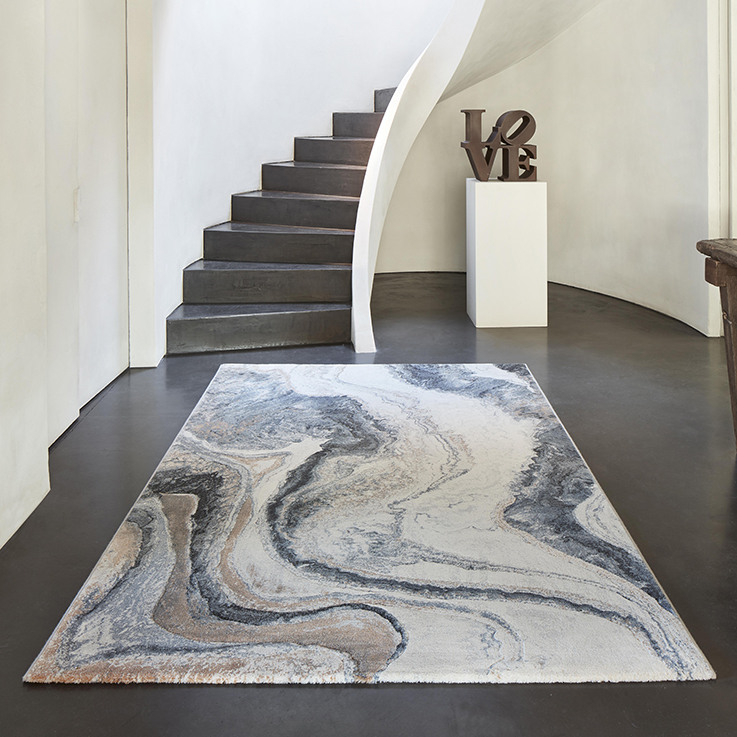
A hardwood floor running unbroken through a big open main level is the thing most Ontario homeowners now want, and it creates a specific problem: the eye reads the whole storey as one surface. Nothing marks where the sitting area starts. The furniture has no ground to stand on. And the room rings, because there is no soft material anywhere below waist height.
Rugs are the layer that fixes all three, and they are the only part of the floor you can change your mind about. The plank is a fifteen-year decision. The rug on top of it is a three-year one, and that is why layering has become the default approach and not an afterthought.
The Short Answer
Size the rug to the furniture, leave 6 to 18 inches of bare floor between the rug and the walls, and pick a tone that is deliberately different from the floor, not close to it. Those three get most layered rooms right.
The mistake worth naming up front is the near-match: a warm mid-brown rug on a warm mid-brown floor. It looks safe on a screen and it reads as flat in the room, because layering only registers when there is a difference to register. If the rug is going to be the same tone as the floor, it has to differ in texture or pattern instead, or there is no point putting it down.
Worth saying where this conversation usually starts, because it changes the advice. Almost nobody arrives at layering from a problem. They arrive with it — from a designer they are working with, or from a room they saw and liked. That is a good reason to do it and a bad reason to skip the sizing, because an idea carried in from another room comes without that room’s dimensions attached.
What the Floor Cannot Do on Its Own
Five things, and they are a mix of how the room looks and how it behaves.
- Draws the boundary — tells the eye where the seating area is, which in an open plan is the job the walls used to do.
- Adds visual weight — balances dark walls, a heavy sofa, a large fireplace. A room can be furniture-heavy at eye level and empty at floor level, and it feels top-heavy until something sits underneath.
- Kills the echo — hard floor, hard walls and a flat ceiling make a room that rings. This is the benefit people notice fastest after the fact and think about least beforehand.
- Warmth underfoot — the difference between hardwood and rug at seven in the morning in February is not subtle, and it matters most in the two feet beside a bed and in front of a sofa.
- Takes the wear — grit, footfall and claws land on the rug and never on the finish. That is a whole subject of its own; do area rugs protect hardwood floors covers where to place them for wear, which is a different map, and the two goals do not always want the rug in the same spot.
Contrast: How Rug and Floor Read Together
Contrast is the lever that does the most work, and it is directional — a light rug on a dark floor does not produce the same room as the reverse.
| Floor | Rug | What the room does | Watch for |
|---|---|---|---|
| Dark hardwood | Light, solid or subtle | Opens up; the room reads brighter and larger | Shows soil quickly in a busy room |
| Light oak or pale vinyl | Dark or saturated | Grounds a space that otherwise floats | Can visually shrink a small room |
| Plain, even grain | Patterned | Adds the movement the floor lacks | Pattern competing with wallpaper or curtains |
| Busy grain, or patterned tile | Solid or near-solid | Calms the field, gives the eye somewhere to rest | Going so plain it reads as a gap |
| Any tone | Same tone | Reads flat — the layering does not register | Only works if texture or pile does the contrasting |
How much contrast depends on what the room is for. A bedroom generally wants less; a room meant to make an impression when you walk in wants more. Neither is a rule, and both are easier to judge with the rug in the actual room under the actual light — showroom lighting is brighter and cooler than almost any living room in Ontario, and it flatters greys in particular.
Zoning an Open-Concept Floor
This is where layering earns the most. When the wall between the kitchen and the living room came out, so did the signal telling you which room you were standing in. A rug puts that signal back without putting the wall back.
The living-room rug marks the seating zone and separates it from the dining and kitchen areas. A rug under the dining table does the same for eating. Smaller rugs can flag a transition or a reading corner. Without them, an open plan tends to read as one large undifferentiated room and not three connected ones, usually the opposite of why the wall came out. If the flooring itself is still being decided, flooring for open-concept homes covers how transitions and sightlines work when one floor runs through everything.
One caution on multiple rugs in sight of each other: enough difference that it looks chosen, enough in common that it looks coordinated. Two rugs from the same family in adjacent zones works. Two rugs in the same colour but different patterns usually looks like an accident.
Leaving a Margin at the Wall
Six to eighteen inches of bare floor between the rug and the wall is the band that reads as deliberate. Under six inches and the rug looks like broadloom that was cut short. Over eighteen and it starts to look adrift, as though it were meant to be bigger.
The exception is framing on purpose: 24 to 36 inches of floor all round, which reads as formal and intentional in a large room and as a mistake in a small one. Scale the offset to the room — a big room carries a big margin, a 10-by-12 does not. The actual dimensions to work from are in the room-by-room size guide.
Rugs read differently at home than under showroom lighting, and we would rather you found that out before buying. Book an in-store appointment and ask about seeing options in your own room.
Choosing for the Room’s Job as Well as Its Look
The design decision and the practical one have to be made together, because a rug that suits the look and not the use gets replaced early.
| Room | Pile | Fibre priority | Pattern |
|---|---|---|---|
| Living room | Low to medium | Durability | Something that disguises wear |
| Dining room | Low — chairs must slide | Stain resistance | Busy enough to forgive a spill |
| Bedroom | Higher, for warmth | Comfort | Free choice; traffic is low |
| Hall or entry | Low and dense | Durability, washability | Dark or patterned |
| Open-plan zone | Low to medium | Durability | Coordinated with the neighbouring zone |
Low pile in a dining room is not a stylistic preference. A chair leg on a thick pile catches every time, and it is the same failure as an undersized dining rug arriving by a different route. Which fibre delivers each of these columns is set out in wool versus synthetic; for the hardest single room to get right, living-room rugs goes further.
Combinations That Disappoint
- Too small for the furniture. The commonest failure by a wide margin, and the one nothing else compensates for.
- Floating with nothing on it. A rug touching no furniture is decoration lying on the floor, not a layer.
- Matching the floor tone too closely. The layering effect disappears and you have paid for texture you cannot see.
- A pad that shows. Cut or ordered to the rug’s exact size, it peeks out along one edge and undoes the finish of the whole arrangement.
- A pad that reacts with the finish. The serious one. Against hardwood, PVC and synthetic rubber can leave marks only a sander will lift.
The last two are both pad problems — a fair indication of how much of this hangs on a component nobody looks at. Use felt-and-rubber or natural rubber, labelled safe for hardwood, cut about two inches under the rug on every side — the pad guide has the detail. The rest of the list appears in the rug mistakes guide.
The Rug Is Not the Only Soft Thing in the Room
A rug chosen alone can fight everything else. It has to sit with the furniture layout and not against it, relate to the wall colour without matching it, and coordinate with whatever is at the windows, the pairing most often left until the rug is already down.
Curtains, blinds and shutters are the other large soft surface in most rooms and the other thing that reads as texture from across the space, so they are worth deciding alongside the rug, not after it. Matching window coverings with flooring works through that combination, and the window coverings guide covers the options. A rug that is slightly less striking on its own is frequently the one the room needed.
Layering a Room, in Order
- Fix the furniture layout. The rug is sized to that, not to the room.
- Size the rug, and check the 6-to-18-inch margin at the walls with tape before you buy.
- Choose the contrast direction against the floor you actually have, in the light you actually have.
- Then choose the fibre and pile for what the room does all day.
- Order the pad with the rug, hardwood-safe and two inches smaller each way.
Size, then contrast, then material, then pad — in that order, because each one narrows the next. Reversing it is how people end up with a rug they like that does not fit the room. The full decision, including everything upstream of layering, sits in the complete area rug guide, and if the floor underneath is still being chosen, the hardwood guide is the other half of the conversation.
Related Guides
A few other guides connected to this topic:
- How to Choose the Right Area Rug for Your Space (Size, Material & Placement Guide) — The complete area rug pillar.
- Area Rug Size Guide (Room-by-Room) — The dimensions behind the margins above.
- Do Area Rugs Protect Hardwood Floors? — Placing for wear instead of for looks.
- Best Rugs for Living Rooms: Sizing, Material & Style Guide — The hardest room in the house.
- How to Match Window Coverings With Flooring — The other soft surface in the room.
- Hardwood Flooring Guide for Ontario Homes — The complete hardwood pillar.
- Best Flooring for Open-Concept Homes — Zoning from the floor up.
- Flooring Installation — If the hard floor is going in first.
- Why Alexanian — Floors, rugs and window coverings under one roof.
Want Help Choosing Rugs That Actually Work in Your Space?
The best way to choose what’s right for your home is to see the options side by side. Book an in-store appointment at one of our 17 Ontario showrooms and one of our consultants will walk you through what fits your space, your needs, and your budget — or request an in-home visit if that’s easier.
Frequently Asked Questions
Why do hard floors often need rugs?
Because a continuous hard surface gives the eye no boundaries, gives the furniture no ground, and gives sound nothing to absorb it. A rug supplies all three, plus warmth underfoot and protection for the finish.
How far should rugs sit from walls?
Six to eighteen inches. Less looks like badly fitted broadloom; more looks adrift. If you want a deliberately formal framed effect in a large room, 24 to 36 inches works — but not in a small one.
Can rug pads damage hardwood floors?
The wrong ones can. PVC, latex and adhesive backings can react with a hardwood finish and leave marks needing sanding. Use felt-and-rubber or natural rubber labelled safe for hardwood, and replace any pad that smells strongly or leaves residue.
Should rugs match flooring colour?
No — that is the mistake this guide is mostly about. A near-match reads flat, because layering only works when there is a difference to see. Coordinate the tones and make the difference deliberate, or contrast in texture if the colours must be close.
Can you put a rug over tile?
Yes, and the reasons change. Tile needs almost no protecting, so the rug is there for warmth, softness and sound — which in an Ontario house is a stronger argument in January than any design one. Use a pad, because tile is smoother than wood and rugs travel further on it.