
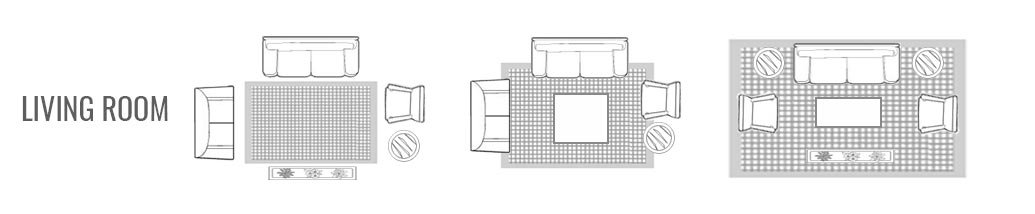
Almost every rug mistake is a sizing mistake, and almost every sizing mistake runs the same direction: too small. The rug ends up marooned in the middle of the room with the furniture stood around it on bare floor, reading as a placemat where it was supposed to read as the thing holding the room together.
The dining room is where it stops being cosmetic. A rug that does not reach past the chairs means every person who sits down drags a chair leg over the edge, and the rug walks a little further out of position each meal. That is not a look you get used to; it is a daily irritation you eventually replace the rug to escape.
The Short Answer
In a standard living room, start at 8×10 and go to 9×12 if the room is bigger than about 12 by 14 feet. In a dining room, the rug must clear the table by at least 24 inches on every side. In a bedroom, size to the bed and not to the room. Those three rules cover the large majority of Ontario homes.
And the tiebreaker, worth more than any of the rules above: when you are stuck between two sizes, buy the larger one. A rug an inch or two too big is something you will not notice. A rug a foot too small is the thing you will notice every day.
Size Beats Everything Else You Choose
Size decides how the furniture relates to the rug, how the room reads in scale, and how much floor stays on show. Get it right and the pattern and colour decisions become easy, because you are choosing within a placement that already works. Get it wrong and no amount of quality rescues it — you spend the next several years trying to make a rug you like sit somewhere it was never sized for.
Fibre and pile are the other half of the decision, and they are largely independent of this one. That is the useful part: settle the size here, then take our guide to choosing an area rug for material and placement without having to revisit the dimensions.
Rug Sizes by Room
Start here, then read the room-specific notes below for the placement that goes with each size.
| Room | Sized to | Usual size | Larger room | The rule that governs it |
|---|---|---|---|---|
| Living room | The seating group | 8×10 | 9×12, or 10×14 with a big sectional | Front legs of every seat on the rug, minimum |
| Dining room, 6 seats | The table | 8×10 | — | 24 inches clear past the table on all sides |
| Dining room, 8 seats | The table | 9×12 | 10×14 | Same 24-inch rule |
| Round dining table | The table | Round, 4 ft wider than the table | — | Chairs stay on the rug all the way round |
| Bedroom, king | The bed | 9×12 | — | 18 to 24 inches showing past the bed |
| Bedroom, queen | The bed | 8×10 | 9×12 | Same |
| Bedroom, twin | The bed | 5×8 | 6×9 | Same |
| Hallway | The corridor | Runner | — | 4 to 6 in. of floor each side, 18 to 24 in. at each end |
| Entry | The doorway zone | 4×6 | 5×7 | Clear of the door swing |
Living Rooms: Three Placements, Three Prices
All three are legitimate, and the choice is mostly budget, not taste.
- Everything on the rug — every leg of every piece sits on the rug and the rug runs past all of it. Needs 9×12 or bigger and produces the most generous, finished result. It is also the most expensive way to do it.
- Front legs only — sofa and chairs put their front legs on the rug and their back legs on the floor. An 8×10 usually does it. This is the standard modern arrangement and the best value in the list.
- Floating between the seats and the coffee table — no furniture on the rug at all. It works in a genuinely small room and nowhere else; it disconnects the seating from the rug, defeating the whole purpose.
Below 5×8 in a standard living room, the arithmetic stops working whatever the placement. There is more on getting the whole living-room arrangement right in our living-room rug guide.
Sectionals
The rug wants to reach at least the front edge of the sectional and ideally past it on the open side. An 8×10 or 9×12 handles most standard sectionals; a large U-shape usually needs 10×14 before the rug is still visible outside the furniture footprint.
The mistake worth naming: buying a rug that fits neatly inside the sectional’s opening. It shrinks the seating area visually and leaves the sofa looking like it is hovering over a mat.
Dining Rooms: The 24-Inch Rule
This is the strictest sizing rule in the house, and the chairs set it, not the table. Twenty-four inches of rug clear of the table edge on every side means a chair pulled out to sit down still has all four legs on the rug. Anything less and the back legs catch the edge on the way out and on the way in.
Measure your own table before you trust the standard sizes. A 60-inch six-seat table plus 24 inches at both ends comes to 108 inches — 9 feet — so an 8×10 works lengthwise only if the table is on the shorter side of standard. This is the single most common place where the published minimum and the actual room disagree, and it is why the tape trick below is worth ten minutes.
Bedrooms
Bedroom rugs are sized to the bed, not the room, because the bed is what the rug has to frame. Two placements work:
- Lower two-thirds — the rug slides under the bed from partway up, showing past the foot and down both sides, stopping short of the nightstands. Cheaper, because you are not paying for rug that lives under the headboard.
- Fully under — headboard and nightstands all on the rug. The better-looking of the two, and it costs a size up.
What you are buying in a bedroom is the first step out of bed on a February morning, which makes pile and fibre unusually important here — bedroom rugs goes into both.
Hallways and Entries
A runner wants 4 to 6 inches of bare floor showing along each side and 18 to 24 inches at each end. The gap at the ends is what stops it reading as badly fitted broadloom.
Entries run 4×6 or 5×7 depending on the space. In an Ontario mudroom in February the sizing question is secondary to the material question: salt, slush and grit want something washable, and a decorative rug in that spot is a rug you are going to be disappointed by. Rugs for high-traffic areas covers what survives an entryway.
Bring the room’s dimensions and a photo and we will size it with you in ten minutes — book an in-store appointment and we can lay out the actual sizes on the showroom floor before you commit to one.
Shape, and When It Is Worth the Trouble
Rectangular is the default because furniture and walls are rectangular, and matching them is the path of least resistance. Round rugs earn their place under a round table, in a circular conversation grouping, and in an entry; in a plain rectangular room they fight the geometry and are harder to place well.
Runners belong in hallways, galley kitchens and anywhere narrow. Octagons and other unusual shapes are rare because they only work when the shape itself is the point of the room, and that is a design decision and not a sizing one.
Telling When a Rug Is Too Small
Undersizing is easier to diagnose after the fact than before it. The tells:
- Furniture legs on bare floor outside the rug edge. The most reliable single signal.
- The rug floating unattached in the middle of the room with nothing standing on it.
- People walking on bare floor to get between the rug and the doorway. Traffic is showing you where the rug should have reached.
- Chairs catching the edge at the dining table — the definitive version, because it is functional and not just visual.
- It reads as a mat under the furniture, not as the base of the room.
Undersizing is the first entry in the rug mistakes guide for a reason: it is the most common and the least fixable, because the only remedy is a different rug.
How Much Floor to Leave Showing
How much floor you leave showing is a real decision, not a leftover. On hardwood and on vinyl plank, a bigger rug covers more of what you paid for and brings more warmth and contrast; a smaller one keeps the floor as the main event. Over tile the rug is doing something tile cannot — adding softness and warmth — so in a living area a larger rug generally earns its keep.
Over broadloom the logic inverts. A small accent rug can define a zone within a carpeted room, but a large one just buries the carpet underneath it and reads as a mistake. And on any hard floor, size the pad in the same breath: a pad is what stops the rug wearing from underneath, and it wants to be about two inches smaller than the rug in each direction so it tucks out of sight and does not peek past the edge. Confirm it when you order; do not assume the supplier matched it.
Prove the Size With Painter’s Tape
The most reliable sizing tool costs about four dollars and catches nearly every mistake in this guide before it becomes a return.
- Tape the proposed rectangle onto the floor at full size.
- Walk the room the way you normally do, and see whether your feet stay inside the tape.
- At the dining table, pull every chair out as though you were sitting down. All four legs inside the tape, or size up.
- Sit on the sofa and look at where the edge falls relative to your feet and the coffee table.
- Leave the tape down for a day or two if you can. Sizing mistakes tend to announce themselves overnight.
If the tape and the standard size disagree, the tape is right.
Related Guides
A few other guides connected to this topic:
- How to Choose the Right Area Rug for Your Space (Size, Material & Placement Guide) — The complete area rug pillar.
- Best Rugs for Living Rooms — Sizing plus arrangement in the hardest room to get right.
- Rug Buying Mistakes to Avoid (And How to Get It Right the First Time) — Undersizing heads the list.
- Do You Need a Rug Pad? What It Does, Why It Matters, and When It Makes a Difference — Including how to size one.
- Layering Rugs Over Hard Floors — How much floor to leave showing, and why.
- Hardwood Flooring Guide for Ontario Homes — What the rug is sitting on.
- How to Choose the Right Flooring for Your Home in Ontario (Complete Guide) — The complete flooring decision pillar.
- Flooring Installation — If the floor under the rug is changing too.
- Why Alexanian — A century of rugs across 17 Ontario showrooms.
Want Help Choosing the Right Rug Size for Your Space?
The best way to choose what’s right for your home is to see the options side by side. Book an in-store appointment at one of our 17 Ontario showrooms and one of our consultants will walk you through what fits your space, your needs, and your budget — or request an in-home visit if that’s easier.
Frequently Asked Questions
What size rug do I need for my living room?
An 8×10 in a standard room, 9×12 once the room passes roughly 12 by 14 feet, and 10×14 with a large sectional. Below 5×8 the rug stops anchoring anything.
How big should a dining-room rug be?
Big enough that there are 24 inches of rug past the table on every side, so a chair pulled out still has all four legs on it. Measure your table first — a long six-seat table plus that clearance can need 9×12 where the published minimum says 8×10.
What size rug for a king bed?
9×12, which leaves 18 to 24 inches showing on all sides. An 8×10 fits a smaller bedroom but sits tight against the bed and looks it.
Can a rug be too big?
It can. A rug that runs nearly to the walls makes the room look smaller and reads as fitted carpet that did not quite fit. Leave 6 to 18 inches of floor showing round the perimeter. That said, if you are choosing between one size too big and one size too small, too big is the far cheaper error.