
High traffic is a matter of concentration, not of how busy the house is. A 600-square-foot living room in constant use spreads that use over 600 square feet. A hallway three feet wide takes the same number of footsteps and puts every one of them on the same thirty square feet.
So the rug that is doing fine in the living room fails in the hall, and why a high-traffic rug is a different specification, not a dearer version of the same thing. Four decisions carry it: fibre, pile, pattern and the pad.
The Short Answer
Solution-dyed nylon or wool, in a low dense pile or a flat weave, patterned or multi-toned, not solid, on a non-slip pad. That specification handles almost any busy spot in a house.
And the part people resist: in a high-traffic spot, choose the forgiving rug over the striking one. A solid pale rug in a hallway shows a wear path within months and a footprint within a day. The rug that looks best in the showroom is very rarely the rug that still looks good in that hallway two years later, and that is a trade worth making deliberately.
Entry rugs are the exception to everything: treat them as consumable. Three to five years is a realistic life, because they are absorbing the grit that would otherwise reach every other floor in the house.
Where the Wear Concentrates
These spots are consistent from house to house, and they are worth identifying before choosing anything, because a rug in one of them needs specifying for the wear, not for the room.
- The first six to eight feet inside the front door. The worst conditions in the house, and in an Ontario winter it is not close.
- Main hallways. Narrow, so the whole household walks the same strip.
- Kitchen runs — fridge to sink, sink to stove. Short distances, enormous repetition, and spills.
- Stair runners and landings. Every trip between floors, plus the pivot at the bottom.
- Family rooms with children or animals. Not a narrow path, but continuous use plus everything that gets spilled on it.
Fibre, Which Decides Most of It
| Fibre | Under traffic | Against stains | Verdict for a busy spot |
|---|---|---|---|
| Solution-dyed nylon | Best of the synthetics; recovers from compression | Exceptional — colour is locked in the fibre, so even bleach-based treatments leave it alone | The default recommendation |
| Wool | Excellent; crushes and springs back | Very good on water-based; wants wool-safe products | Best if the budget allows and the spot is not an entry |
| Polypropylene | Handles use, but shows wear earlier than nylon | Excellent except on oil | Good value; the honest budget choice |
| Polyester | Flattens along the walking line and stays flat | Fine on water-based, weak on oil | Wrong fibre for this job |
Solution-dyed is the phrase to ask about. The pigment goes into the fibre as it is extruded, so there is no dyed surface layer to abrade off or bleach out, and that is why a nylon rug can take treatment that would ruin the colour on a conventionally dyed one. Wool versus synthetic rugs compares all four across cost and lifespan as well.
Pile: Lower Is Tougher
The reasoning here is mechanical, not aesthetic. Less pile means less fibre to crush, less depth for grit to fall into, and less material to mat together along the path everyone walks. A flat weave takes that to its conclusion — there is almost nothing to compress.
| Construction | Holds up | Vacuums | Where it suits |
|---|---|---|---|
| Flat weave | Best | Easiest | Halls, entries, kitchens, under dining chairs |
| Low dense pile | Very good | Easy | Almost any busy room; the best all-rounder |
| Medium pile | Acceptable | Moderate | Family rooms, if density is high |
| Plush or shag | Poor — mats in the path | Difficult | Bedrooms and formal rooms only |
Density is the specification that goes with pile height and gets asked about least — fibres per square inch, the thing holding the pile upright under repeated load. A dense low pile outlasts a sparse one at the same height by a wide margin, and it is worth asking for the figure; feel is a poor guide to it.
In a hallway there is a secondary benefit: a flat weave or low pile sits closer to the floor, so there is less edge to catch a foot in a corridor people move through quickly.
Pattern Is Doing Real Work
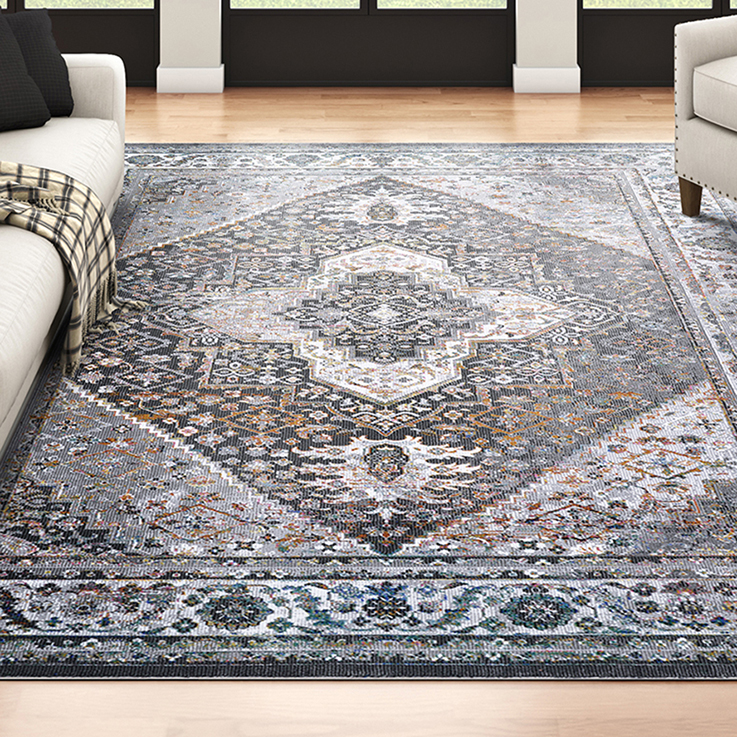
Pattern determines how long the rug looks new — a separate question from how long it lasts. A multi-toned or patterned rug lets the eye read variation as design; a solid rug lets the eye read the same variation as wear.
Mid-tone neutrals are the practical middle: they hide light soil and dark soil, where pale rugs show mud and dark rugs show dust and salt. Pale solids in a hallway are the combination that disappoints fastest. Living-room rugs covers the same decision where looks carry more weight and traffic carries less.
Entries Are a Different Product
An entry rug faces conditions nothing else in the house comes near: outdoor grit, road salt, sand and standing meltwater, arriving daily for five months of the year, concentrated into a few square feet at every door.
Indoor-outdoor constructions, washable rugs and dense low piles all belong here; anything precious does not. Our position is that this is the one place in a house to buy deliberately cheaply and replace on a cycle — three to five years — because the rug is doing exactly what it was bought to do: be destroyed in place of your floor. Trying to make an entry rug last a decade means either accepting a shabby entrance or accepting grit reaching the rest of the house.
On sizing, a hallway runner wants 18 to 24 inches of bare floor at each end and 4 to 6 inches down each side; running it wall-to-wall makes it read as badly fitted broadloom. Dimensions for both are in the size guide.
An entry rug and a hallway runner are different specifications, and getting them the wrong way round is expensive. Come in and see the difference and we will show you what holds up by an Ontario front door.
The Pad Is Not Optional Here
Everything a pad does becomes more important as traffic rises, and one thing changes category entirely. A rug that slides in a bedroom is a nuisance. A rug that slides in a hallway or at the foot of the stairs is a hazard, and it is the one argument in this guide that is about safety and not about value.
Beyond that: the pad takes the compression that would otherwise wear the pile from its base, and stops the rug grinding trapped grit into the floor beneath. Ask for a non-slip type and for the density figure in these locations, and do not accept the standard pad — the pad guide compares the options and flags which are unsafe on hardwood.
Maintenance Is Part of the Specification
A high-traffic rug only keeps protecting while it has capacity left. Packed solid with grit, it stops absorbing and starts acting as an abrasive mat on the floor it was covering.
- Vacuum twice a week. This is the whole game, and twice is what a household actually keeps up.
- Blot spills within the hour. Traffic drives a spill deeper faster.
- Rotate every three months to move the wear path — the interval the plant that washes them settles on, and the one that keeps a runner from wearing into a stripe.
- Professional wash at the short end of whatever interval the rug would otherwise get — our plant puts an Oriental or specialty rug at two to four years, and a hallway or an entry is exactly the case that pulls it in.
Consistent care is credited with 30 to 50 percent more life on a busy rug. The routine in full is in caring for area rugs at home, and once home care has stopped making a difference, our rug cleaning and washing guide sets out what an in-plant wash gets to.
Cheaper Than Refinishing the Hallway
Worth keeping in view, because it changes how the rug’s price reads. In these locations the rug is wearing out in place of the floor: fewer scratches and less dulling on hardwood traffic paths, slower thinning of a vinyl wear layer, less soil ground into grout lines.
Replacing a hallway rug every five to ten years costs a fraction of refinishing the hallway. Do area rugs protect hardwood floors works through where to place rugs for wear specifically, and that is not always where looks would put them. And if the floor and not the rug is up for decision, best flooring for high-traffic areas is the same question one layer down.
Specifying a High-Traffic Rug in Five Steps
- Decide whether the spot is genuinely high traffic. Concentration, not household busyness.
- Solution-dyed nylon or wool. Polypropylene if the budget says so; not polyester.
- Low dense pile or a flat weave, and ask for the density; do not judge by hand.
- Patterned or multi-toned, in a mid tone. Resist the pale solid.
- Non-slip pad, and a replacement expectation written down: three to five years at an entry, five to ten elsewhere.
Step five changes how people feel about the whole purchase, because a rug that was always going to be replaced in four years is not a disappointment when it is. For the decision from the beginning, the pillar guide to choosing a rug covers size and placement, and the mistakes guide covers the ways this goes wrong. If the traffic is coming from animals, what works with pets applies to rugs as much as to broadloom.
Related Guides
A few other guides connected to this topic:
- How to Choose the Right Area Rug for Your Space (Size, Material & Placement Guide) — The complete area rug pillar.
- Wool vs Synthetic Rugs — The fibre decision in full.
- Do You Need a Rug Pad? — Non-slip is a safety matter in a hallway.
- How to Care for Area Rugs at Home — Maintenance is half the lifespan.
- Best Flooring for High-Traffic Areas — The same question about the floor itself.
- Best Carpet for Stairs — Where a runner and broadloom compete.
- Area Rug Cleaning & Washing Guide — What a proper wash recovers.
- Flooring Installation — When the floor underneath has had enough.
- Why Alexanian — Rugs, floors and our own washing plant.
Want Help Choosing the Right Rug for High-Traffic Areas?
The best way to choose what’s right for your home is to see the options side by side. Book an in-store appointment at one of our 17 Ontario showrooms and one of our consultants will walk you through what fits your space, your needs, and your budget — or request an in-home visit if that’s easier.
Frequently Asked Questions
What rug material lasts longest in high-traffic areas?
Solution-dyed nylon and wool. Nylon takes the harder cleaning because the colour is locked into the fibre; wool recovers better from compression and looks better as it ages. Polypropylene is the reasonable budget answer. Polyester is the one to avoid in a busy spot.
Why do flat-weave rugs hold up better in hallways?
There is almost no pile to crush, no depth for grit to settle into, and nothing to mat along the walking line. They also vacuum easily, which keeps maintenance consistent, and they sit flatter, so there is less edge to trip on.
Should a hallway runner be the full length of the hall?
No. Leave 18 to 24 inches of bare floor at each end and 4 to 6 inches down each side. Run it wall-to-wall and it reads as fitted carpet that was cut wrong.
How often should high-traffic rugs be replaced?
Entry rugs, three to five years. Other high-traffic rugs, five to ten. Better fibre and consistent vacuuming push both toward the top of the range; treat the entry figure as a plan rather than a disappointment.
Is a wool rug worth it in a hallway?
In an interior hallway, yes — wool handles the compression well and ages gracefully. Immediately inside an exterior door, we would not: salt and meltwater are hard on wool and that rug is on a replacement cycle anyway. Put the money into the hall and buy something washable at the door.