
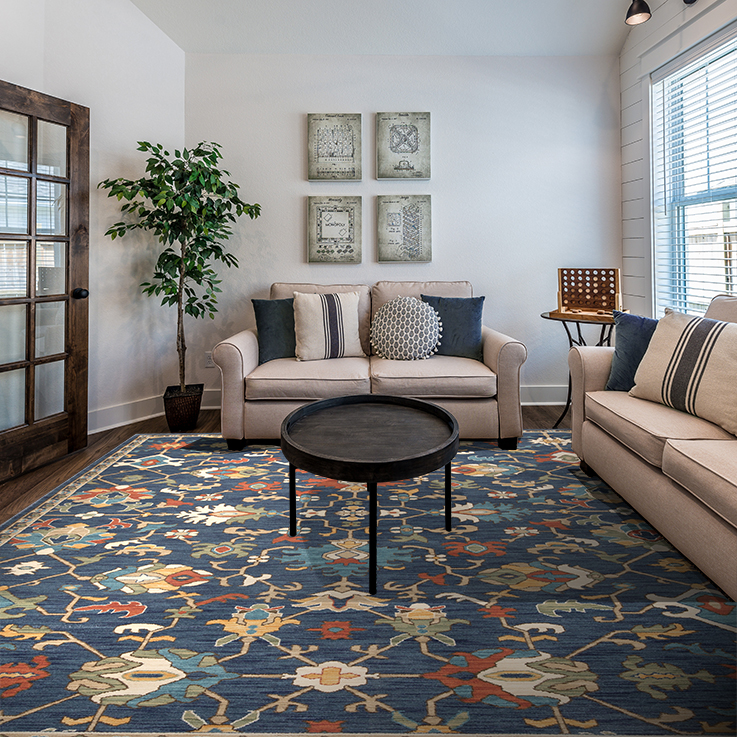
Rug regret has a short list of causes. Wrong size, wrong material for what the room actually does, no pad, and a placement nobody worked out before the rug arrived. Almost everything else is a variation on one of those four.
What makes them worth writing down is that none is subtle and none is discovered late. They are all decidable in advance, with a tape measure and an honest answer about how the room gets used, a better position than most household purchases put you in.
The Short Answer
Buy bigger than feels necessary, buy the fibre the room deserves over the one you like best, and buy the pad at the same time. Those three prevent most of what follows.
The one worth stating separately, because it costs the most and is the least reversible: undersizing. A too-small rug cannot be adjusted, padded, cleaned or arranged into working. It is the only mistake on this list whose sole remedy is a different rug. Take one home for up to a week before you commit and the whole question goes away, which is why we offer it.
All Eight, at a Glance
| The mistake | How it shows up | Recoverable? |
|---|---|---|
| Too small | Furniture on bare floor; rug reads as a mat | No — buy again |
| Wrong fibre for the room | Crushing, staining or shedding within a year | Sometimes — move it to a quieter room |
| No pad | Sliding, curling edges, early wear, scratched floor | Yes — buy the pad |
| Placement never planned | Traffic goes around the rug, never over it | Sometimes — rearrange the furniture |
| Maintenance you will not do | A rug that looks tired years early | Partly — change the routine, not the rug |
| Pattern conflict | The room feels busy and tiring | Yes — but usually by changing something else |
| Never seen at home | The colour is wrong in your light | Yes — take it home for a week first |
| Ignoring how the room is really used | All of the above, arriving together | No |
1. Buying Too Small
This is the mistake, and everything else is a footnote to it. A rug adrift in the middle of the room with the sofa and chairs standing around it on bare boards makes the room feel less put-together than no rug at all, because it draws a boundary in the wrong place and then asks the furniture to ignore it.
What drives it is worth knowing, because it is not what people assume. It is rarely price. On our floor the smaller size gets chosen because of how the furniture is already arranged — the sofa is where it is, the coffee table is where it is, and the rug gets sized to the gap between them instead of to the room. That is the wrong way round. The rug sets the boundary and the furniture stands on it.
The threshold in a living room is that the front legs of every major piece stand on the rug. In a dining room it is 24 inches of rug beyond the table on all four sides, so a chair pulled out still has all four feet on it. In practice that means 8×10 as a floor for most living rooms and 9×12 once the room is genuinely large. When you are between sizes, take the larger one — the price gap between adjacent sizes is small next to the rug, and the visual penalty is entirely one-directional. Full dimensions by room are in the size guide.
2. Choosing the Fibre for the Photograph
The second-commonest failure, and it takes about a year to reveal itself. A material chosen on looks alone lands in a room that punishes it, and by the time that is obvious the rug is no longer returnable.
| Material | Where it goes wrong | What happens | Where it belongs |
|---|---|---|---|
| Wool | Under a dining table | Absorbs spills; costly to put right repeatedly | Living rooms, bedrooms, formal rooms |
| Jute and sisal | Kitchens, anywhere wet | Stains readily; breaks down with wet cleaning | Dry, low-spill rooms |
| Cotton flat-weave | Hallways; under heavy furniture | Crushes and takes permanent dents | Bedrooms, light use, washable accents |
| Silk | Anywhere with traffic, kids or pets | Fails quickly and cannot be rescued | Formal rooms with almost no footfall |
| Polyester | Family rooms and pathways | Packs flat along the walking line | Bedrooms and quiet rooms |
Every material in that table is excellent somewhere. The error is never the material; it is the pairing. Wool versus synthetic sets out what each fibre actually does under traffic and under spills.
3. Skipping the Pad
The pad is roughly five to ten percent of the rug’s price and is generally credited with 30 to 50 percent more life. Removing it to save the five percent is the worst trade available in the category, and it takes several years to notice, and that is why it keeps getting made.
Without one the rug slides, the edges curl, the pile wears unevenly from the base up, and on a hard floor the rug grinds trapped grit into the finish. On hardwood there is a further trap: the wrong pad is worse than none, because PVC and synthetic rubber can react with the finish and leave marks that need sanding out. The pad guide covers which types are safe on what.
4. Never Working Out Where It Goes
Placement decides whether the rug is part of the room or an obstacle in it. The test is traffic: people should walk over the rug on their normal routes, not around it. A rug that everyone steps round has been put in the wrong place, and it will keep signalling that until it moves.
Painter’s tape on the floor settles it before any money changes hands. Mark the rectangle, walk your usual routes, pull the dining chairs out, sit on the sofa and look at where the edge lands. It takes ten minutes and it catches size and placement errors in the same pass.
5. Buying a Maintenance Routine You Will Not Follow
Different rugs ask for different care, and the honest question is not which rug is best but which upkeep you will actually do. Wool wants gentle vacuuming with the beater bar off and wool-safe products. Synthetics take standard vacuuming and tolerate stronger treatment. Jute and sisal have very few cleaning options at all, and a badly soiled natural-fibre rug is more often replaced than restored.
An Oriental or specialty rug wants a professional wash every two to four years, sooner in a busy room — our own plant’s figure, and the plant is equally clear that it is a reference and not a rule. The twelve-to-twenty-four-month interval you will see quoted is the one for wall-to-wall carpet.
The reason to take the routine seriously is what the plant sees when rugs come back after fifteen or twenty years. Construction and origin set the ceiling — handmade Oriental rugs have the best life, and machine-made, tufted and broadloom rugs do not last as long — but within that ceiling it is the maintained rugs that are still worth washing. Quality helps a rug withstand heavy use; regular care is what decides whether it is still worth washing at twenty years.
Caring for area rugs at home sets out the routine; read it before buying, not after, because a beautiful rug on the wrong regime ages faster than a plain one on the right regime.
Most of this list is avoidable in one conversation with a tape measure. Book an in-store appointment, bring the room’s dimensions, and we will tell you honestly if the rug you have in mind is wrong for the room.
6. Pattern Fighting the Room
Something in a room has to be the loudest thing, and the trouble starts when two things apply for the job. A bold rug with bold upholstery produces a room that is tiring to sit in and cannot be fixed by adjusting either one.
Decide the hierarchy first. Bold rug, quiet furniture, and the rug is the focal point. Quiet rug, bold furniture, and the furniture keeps its prominence. Both quiet is a legitimate choice and reads as calm. Both loud is the combination to avoid. Curtains and blinds belong in that calculation too, since they are the other large patterned surface in most rooms — layering rugs over hard floors covers coordinating the two.
7. Never Seeing It in Your Own Light
Showroom lighting is brighter, cooler and more even than any room in a house. Greys in particular shift — a rug that reads as a neutral grey under retail lighting can come home distinctly blue or distinctly brown depending on which way the windows face and what colour the walls are.
This one is real enough that rugs do come back over it. Colour is a reason people exchange a rug, and it is the reason we would rather hand you one to take home for up to a week than talk you into a decision under our lights. A rug that has spent a week on your floor, seen your morning and your evening and sat beside your own furniture, has answered a question the showroom cannot.
Ask about taking a sample home, or about an in-home visit, before committing on anything expensive. Wall colour, adjacent upholstery, the floor underneath and the direction of the daylight all change how the rug reads, and none of them is present in the shop.
8. Buying for the Room You Wish You Had
The mistake underneath several of the others. A formal rug bought for a family room, a pale rug bought for a house with a labrador, a delicate weave bought for the floor children play on.
The room that hosts a dinner once a year and the room that absorbs a family every evening are not the same specification, even when they are the same size. Answer honestly on traffic, spills, pets and children before choosing anything, and let that narrow the field before taste gets involved — rugs for high-traffic areas is written for the honest answer, and if there are animals in the house what works with pets applies to rugs as much as to broadloom.
Salvaging a Rug You Already Bought
Not every mistake is a write-off, and it is worth knowing which are salvageable before replacing anything.
- Too small — move it to a smaller room where it is correctly sized, and buy properly for the original space. It is rarely wasted, just misplaced.
- Wrong fibre — relocate it somewhere its weakness does not matter. A polyester rug that flattened in the family room is fine in a guest bedroom.
- No pad — the easiest fix on the list, and worth doing even years in.
- Soiled beyond home cleaning — a proper wash rescues more rugs than people expect. Try that before deciding it is finished.
The Five-Step Check Before You Buy
- Measure the room and the furniture, then tape the rug’s outline on the floor and live with it for a day.
- Write down what the room really gets: traffic, spills, pets, children. Choose the fibre from that, not from the photograph.
- Decide what the loudest thing in the room is going to be before you choose a pattern.
- See it, or a sample of it, in your own light.
- Put the pad on the same order.
Four of those five cost nothing. For the whole decision in sequence, and not the failure modes, our area rug pillar is the place to start — and if the choice is really between a rug and wall-to-wall for the same room, our carpet guide is the other side of it.
Related Guides
A few other guides connected to this topic:
- How to Choose the Right Area Rug for Your Space (Size, Material & Placement Guide) — The complete area rug pillar.
- Area Rug Size Guide (Room-by-Room) — The fix for mistake number one.
- Wool vs Synthetic Rugs — The fix for mistake number two.
- Do You Need a Rug Pad? — The fix for mistake number three.
- Best Rugs for High-Traffic Areas — Buying for the room you actually have.
- Area Rug Cleaning & Washing Guide — Before you write off a rug that only looks finished.
- How to Choose the Right Carpet for Your Home in Ontario — The complete carpet pillar.
- Flooring Installation — If the floor is changing as well.
- Why Alexanian — Why we would rather talk you out of the wrong rug.
Want Help Choosing a Rug That Actually Works in Your Space?
The best way to choose what’s right for your home is to see the options side by side. Book an in-store appointment at one of our 17 Ontario showrooms and one of our consultants will walk you through what fits your space, your needs, and your budget — or request an in-home visit if that’s easier.
Frequently Asked Questions
What is the most common rug mistake?
Buying too small. Most living rooms need 8×10 as a minimum and 9×12 once the room is genuinely large, and a dining rug needs 24 inches of clearance past the table on every side. It is also the only mistake here with no remedy but a second rug, which is the reason we would rather you took one home for a week first.
How do I choose the right rug material?
From what the room does, not from how the rug looks. Wool for longevity in moderate use, solution-dyed nylon where there is real traffic, polyester where comfort matters more than durability. Keep jute out of wet rooms and silk out of any room with children or animals.
Do I really need a rug pad?
On a hard floor, effectively yes. It stops the rug sliding, takes the compression that wears the pile from underneath, and keeps grit from being ground into the finish. Reckoned to add 30 to 50 percent to the rug’s life for about five to ten percent of its price.
Should I see a rug at home before buying?
On anything expensive, yes. Showroom light is brighter and cooler than domestic light and it changes how colours read — greys most of all. Ask about a sample or an in-home visit.
Can a rug that is the wrong size be salvaged?
Usually by moving it, not by fixing it. A rug that is too small for a living room is often correctly sized for a bedroom or a landing. Relocate it and buy properly for the room that defeated it.