
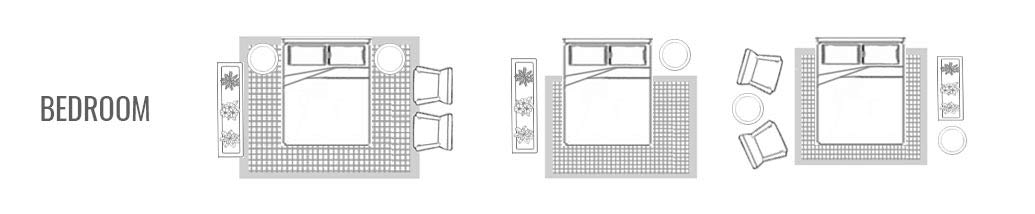
A bedroom rug is judged by one moment: the first step out of bed. In an Ontario house in February that step lands on a floor that has been sitting at whatever temperature the room dropped to overnight, and it is the difference between hardwood and something soft that people actually notice about the room.
Which makes bedrooms the one place in the house where comfort legitimately outranks durability. Traffic is light, spills are rare, most of the time on that floor is spent barefoot — so the specification that would be a mistake in a hallway is the right answer here.
The Short Answer
Size to the bed, not the room: 9×12 for a king, 8×10 for a queen, 5×8 or 6×9 for a twin, aiming for 18 to 24 inches of rug showing past the bed. Then choose for softness — wool if the budget allows, polyester if it does not — in a medium pile around 3/8 to 1/2 inch.
Our position: this is the room to buy polyester in, and the room not to buy solution-dyed nylon in. Nylon’s virtues are stain resistance and resilience under traffic, and a bedroom tests neither. You would be paying for durability the room never asks for and giving up softness it notices daily. The exception is a bedroom that doubles as an office, a playroom or where the dog sleeps — then it is not really a bedroom.
Bedrooms Ask for Something Different
Most rooms ask a floor to survive things. A bedroom asks it to feel like something, and the relationship is more physical than anywhere else in the house — bare feet, standing on one leg to pull on socks, and that first cold step.
Three consequences follow, and they all point the same way. Higher pile becomes reasonable because nothing is going to mat it down. Softer fibres become sensible because nothing is going to abrade them. And sound matters more than it does elsewhere — a rug over hardwood cuts the transmission between an upstairs bedroom and the room below it, which in a house with children is not a small thing. If the flooring itself is still open, best flooring for bedrooms in Ontario weighs carpet against hardwood for exactly these reasons.
Sizing to the Bed
| Bed | Bed size | Rug | Larger room | What shows past the bed |
|---|---|---|---|---|
| King | 76 x 80 in. | 9×12 | — | 18 to 24 in. all round |
| Queen | 60 x 80 in. | 8×10 | 9×12 | 18 to 24 in. all round |
| Double | 54 x 75 in. | 8×10 | — | Generous on both sides |
| Twin | 39 x 75 in. | 5×8 | 6×9 | Past both sides and the foot |
An 8×10 under a king is the common near-miss. It fits, and it sits tight to the bed with barely a handspan showing, which reads as a rug that was bought for a smaller room. Below 8×10 with a king the proportion is simply wrong.
There is a cheaper approach that works better than people expect: a pair of runners, 2×6 or 3×5, one down each side of the bed. You get the soft landing where your feet actually go and you pay for none of the rug that lives under the bed frame. It suits children’s rooms and tight bedrooms, and in a room with a beautiful floor it keeps most of that floor visible. Sizing for every other room is in the room-by-room size guide.
Where to Put It Relative to the Bed
- Under the lower two-thirds — the rug slides under from partway up the bed, showing past the foot and both sides, stopping short of the nightstands. The most common choice and the most economical, because you are not buying rug to hide under the headboard. The bed and nightstands end up framing it.
- Fully under — headboard and nightstands all on the rug. Costs a size up and looks the best of the three. It also means something soft under your feet when you sit on the edge of the bed, which the two-thirds version does not give you.
- At the foot only — a smaller rug across the end of the bed, nothing underneath. For tight rooms, or over a floor you want left mostly on show.
All three are legitimate. The choice is budget and how much floor you want to see, and none of them is a compromise on comfort as long as the rug reaches where your feet land getting out of bed.
Fibre, When Softness Is the Point
Light traffic changes the ranking completely. In a hallway, polyester is the wrong answer; in a bedroom it is frequently the right one.
- Polyester — the softest mainstream synthetic, in deeper and richer colours than nylon at the same money. Its flaw is compression under repeated footfall, and a bedroom does not supply any. Best comfort per dollar in the house.
- Wool — softer again, warmer, quieter, and it will outlive the room’s decor two or three times over. Costs two to four times the polyester. The right answer if you are keeping it.
- Solution-dyed nylon — excellent fibre, wrong room. Unless the bedroom is also an office, a playroom or a dog’s bedroom.
Wool has a second advantage here that gets overlooked: it breathes and it insulates, so a wool rug beside the bed reads as warm in January without feeling stifling in July. The full comparison across cost and lifespan is in wool versus synthetic rugs.
Pile Height
| Pile | Height | Underfoot | The catch |
|---|---|---|---|
| Low | Under 1/4 in. | Firm | Least comfort; but easiest to vacuum and lies flat under furniture |
| Medium cut pile | 3/8 to 1/2 in. | Soft, stable | None worth mentioning — the default recommendation |
| Plush cut pile | 1/2 to 5/8 in. | Luxurious | Shows furniture dents; wants careful vacuuming |
| Shag / high pile | Over 5/8 in. | Best there is | Crushes under the bed permanently; hard to vacuum properly |
Medium cut pile at 3/8 to 1/2 inch is where most bedrooms land, and for good reason — it is most of the comfort of a shag with none of the maintenance argument. Shag genuinely does feel better, and it is defensible in a bedroom precisely because the traffic is light enough to keep it looking presentable; just know that the section under the bed frame will not recover.
Low pile is the choice when the floor is the point and the rug is an accent — more of a design decision than a comfort one, and covered in layering rugs over hard floors.
Pile and softness are decided with your hands, not on a screen. Visit one of our showrooms and stand on a few — barefoot, if you want the honest test.
Yes, Even Here, a Pad
The bedroom is where skipping the pad is most tempting, because the rug is not going anywhere. It still earns its keep, for reasons that have nothing to do with sliding.
The bed is a static load sitting in the same four places for years, and without a pad it compresses the pile into permanent dents. The pad also keeps the rug backing off the floor finish — the reaction problem that turns up on hardwood. And the cushioning is more noticeable in a bedroom than anywhere else, because this is the room you are on the floor barefoot. Felt-and-rubber in 7/16 to 1/2 inch is the standard over hardwood; the pad guide covers the types and which are unsafe on wood.
Coordinating With What Is Outside the Door
Bedrooms usually open onto a hallway in hardwood, vinyl or tile, and the instinct is to match. Coordinate instead. Tones drawn from the same palette but differing in shade or texture read as deliberate; an exact match makes the bedroom feel like a continuation of the corridor, not a room you arrive in.
A clean transition strip at the threshold does the separating, and it is worth agreeing that detail before the floor goes down — what to expect from a flooring installation covers where transitions get decided. And if you are choosing hardwood or vinyl for the bedroom over broadloom, a rug at the bedside recovers most of the comfort of carpet while keeping the floor continuous with the rest of the house. That is the compromise most people are actually after. If wall-to-wall is still in the running, best carpet for bedrooms makes that case properly.
Where Bedroom Rugs Go Wrong
- Too small. The commonest, as everywhere. It floats under the bed and looks lost, and the 8×10-under-a-king is the specific version.
- No pad, so the bed prints itself permanently into the pile.
- Buying a hallway fibre. Paying for durability the room never uses and losing the softness it does.
- Judging the colour in the shop. Bedrooms have the least reliable light in the house — low lamplight at night, oblique daylight in the morning, and often only one window. Showroom lighting resembles neither.
- Shag right up under the bed frame and then being surprised by the flattening.
The lighting one is worth taking seriously in this room in particular. Ask for a sample and look at it in the bedroom at the two times of day you are actually in there. The rug mistakes guide covers the rest of the list across every room.
Choosing a Bedroom Rug in Five Steps
- Measure the bed, then the room. The bed sets the rug size; the room only decides whether you can go up one.
- Pick the placement — fully under, two-thirds, or foot-only — and let that set the budget.
- Choose the fibre for softness. This is the room where that is the correct priority.
- Medium pile unless you have a specific reason to go higher or lower.
- Add a felt-and-rubber pad, two inches smaller than the rug each way, and see a sample in the room’s own light before you commit.
Maintenance in a bedroom is light — weekly vacuuming and a wash at the long end of the normal interval, since there is little being walked in. Caring for area rugs at home has the routine, and the area rug guide covers the whole decision if you are furnishing more than one room.
Related Guides
A few other guides connected to this topic:
- How to Choose the Right Area Rug for Your Space (Size, Material & Placement Guide) — The complete area rug pillar.
- Area Rug Size Guide (Room-by-Room) — Every other room in the house.
- Wool vs Synthetic Rugs — Why polyester earns its place here and nowhere busy.
- Do You Need a Rug Pad? — What the bed’s weight does without one.
- Best Carpet for Bedrooms: Comfort, Style & Long-Term Performance — If wall-to-wall is still an option.
- Best Flooring for Bedrooms in Ontario: Comfort, Sound & Style — The floor under the rug.
- How to Care for Area Rugs at Home — A light routine for a light-use room.
- Flooring Installation — If the bedroom floor is being replaced first.
- Why Alexanian — Rugs, carpet and flooring from one showroom.
Want Help Choosing the Right Bedroom Rug?
The best way to choose what’s right for your home is to see the options side by side. Book an in-store appointment at one of our 17 Ontario showrooms and one of our consultants will walk you through what fits your space, your needs, and your budget — or request an in-home visit if that’s easier.
Frequently Asked Questions
What size rug do I need for my bedroom?
9×12 for a king, 8×10 for a queen or double, 5×8 or 6×9 for a twin — aiming for 18 to 24 inches of rug showing past the bed. Size from the bed, not from the room.
Should a bedroom rug go under the bed?
Usually, yes — either fully under, or from partway up so it stops behind the nightstands. Both work. The only requirement is that the rug reaches the floor your feet land on getting out of bed.
What is the softest rug for a bedroom?
Wool, then polyester, and higher pile in either adds to it. Polyester is the better value; wool is warmer, quieter and lasts several times longer. Both are correct choices in a bedroom in a way neither is in a hallway.
Do bedroom rugs really need a rug pad?
Yes, though not for the usual reason. The rug is not going to slide much; the point is that the bed’s weight sits in the same four spots for years and permanently dents the pile without a pad under it. The extra cushioning is a bonus you feel every morning.
Is a shag rug a bad idea in a bedroom?
Not at all — a bedroom is the one room where the traffic is light enough to keep a shag looking good, and it does feel better than anything else. Two caveats: the part under the bed frame will flatten and stay flat, and it wants suction-only vacuuming rather than a beater bar.