
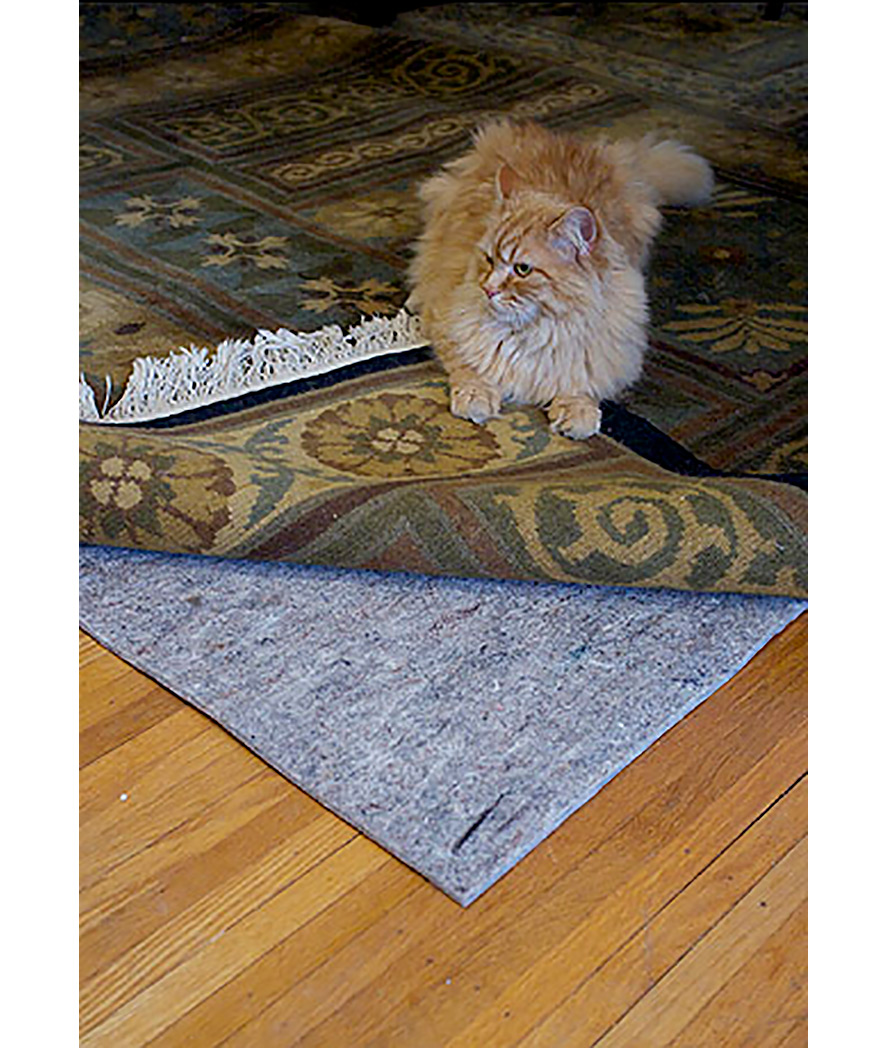
The rug pad is the only part of a rug purchase nobody ever sees, so it is the first thing cut when the total comes in higher than expected. It is also the part doing the work that determines whether the rug lasts eight years or eighteen.
Rugs do not wear out from the top down the way people assume. They wear out from the base, where the pile is ground against the floor by every footstep, and a pad is what stands between those two surfaces. Skip it and you are not economising on an accessory. You are removing the component that protects both the rug above it and the floor below it.
Table of Contents
- The Short Answer
- What a Pad Actually Does
- Hard Floors Change the Question
- Telling There Is No Pad Under There
- Pad Types Compared
- Where It Matters Most — and Where It Matters Least
- Getting the Size Right
- Specifying a Pad in Five Steps
- Related Guides
- Want Help Choosing the Right Rug and Pad Together?
- Frequently Asked Questions
The Short Answer
Yes, on any hard floor, and yes on broadloom too — just a different pad. A quality pad runs roughly five to ten percent of the rug’s price and is generally reckoned to add 30 to 50 percent to its working life. There are very few purchases in this category where the arithmetic is that one-sided.
Over hardwood, get felt-and-rubber or natural rubber, and check the label says it is safe for hardwood. That last part is not a formality. PVC and synthetic rubber can react with a hardwood finish over a few years, leaving marks that only sanding removes — a pad that damages the floor it was bought to protect.
Our honest position: this is the cheapest thing in a rug purchase that changes the outcome, and we would rather see almost anything else left off the order.
What a Pad Actually Does
Five separate jobs, running at once, all of them invisible.
- Stops the rug moving — under footsteps and under furniture. On a smooth floor this is a safety matter as much as a tidiness one, particularly in a hallway or at the foot of stairs.
- Takes the compression — the pad absorbs the crushing force that would otherwise flatten the pile at its base. Base wear is where most rugs actually die, and it is invisible until the pile stops standing up.
- Removes the friction — rug backing ground against a hard floor abrades both surfaces. The pad separates them, extending the life of the rug and the floor at once.
- Protects the finish — from grit trapped underneath, and from the rug’s own backing reacting with the floor.
- Changes how it feels — softer underfoot, more stable to step on, and noticeably warmer over a cold floor in January.
None of these announces itself. The pad’s contribution is the sort you only detect by walking on a rug that has not got one, at which point the difference is unmistakable and slightly annoying.
Hard Floors Change the Question
Over broadloom, a pad is an improvement. Over hardwood, vinyl, laminate or tile it is closer to a requirement, because three specific problems only exist on a hard surface.
The rug slides, and in a corridor that is a hazard and not a nuisance. When it slides it drags whatever grit is underneath it across the finish. And some backings will chemically react with a hardwood finish given a few years of contact, leaving a permanent shadow in the shape of the rug. On a hardwood floor the pad is doing protection work first and comfort work second — the reverse of how most people think about it. There is more on the whole rug-over-wood relationship in do area rugs protect hardwood floors.
Do You Need One Over Wall-to-Wall Carpet?
Yes, and a different one. The problems over carpet are migration, pile crushing where the two layers meet, and the slow ripple that develops when a rug sits on a plush pile. Pads made for over-carpet use are thinner and have a grippy top face that holds the rug without chewing up the carpet underneath. Do not use a hard-floor pad here; it is the wrong thickness and the wrong grip.
Telling There Is No Pad Under There
Most people arrive at this question the hard way, having already lived with the alternative. The symptoms are consistent:
- The rug shifts underfoot and needs straightening every few days.
- Bunching or a standing wrinkle appears along the main walking line.
- The edges curl up and will not lie flat — also a trip hazard.
- Fine scratches on the floor trace the rug’s movement.
- The rug feels dead underfoot — thin, hard, and older than it is.
The scratches cost the real money, because the rug can be replaced and the floor has to be refinished.
Pad Types Compared
Four types cover residential use, and the differences are mostly about grip against cushioning.
| Pad type | Grip | Cushioning | Safe on hardwood | Where it belongs |
|---|---|---|---|---|
| Felt and rubber | Good | Good | Yes, when labelled | The default. Almost any rug on almost any hard floor |
| Natural rubber | Best | Moderate | Yes, properly cured | Runners, entries, anywhere slipping is the main worry |
| Felt only | Low | Best | Yes | Heavy rugs that stay put on their own; comfort priority |
| Foam | Moderate | Moderate at first | Check the label | Budget option; compresses out within a few years |
| PVC / synthetic rubber | Varies | Low | No | Avoid on hardwood entirely — can stain the finish permanently |
For a rug in a main pathway, ask about density as well as type; something around 30 ounces per square yard or heavier holds up where a light pad packs down. Foam is the honest budget answer and it is a real one — a foam pad is considerably better than no pad, it just will not last as long as the rug will.
Pads are the one thing worth buying at the same time as the rug, so the type and the size are matched to it. Book an in-store appointment and we will spec the pad alongside the rug, not by guesswork afterwards.
Where It Matters Most — and Where It Matters Least
The pad earns the most in five situations: a rug in a main pathway or hallway, a house with dogs that shove rugs around, anything over hardwood, a large rug where movement is more visible, and a rug you intend to keep for a long time. In those cases the pad is doing structural work, not just anti-slip work. If the rug is going somewhere genuinely busy, rugs for high-traffic areas covers the fibre and pile side of the same problem.
And the honest other side: there are places where a pad barely matters. A small accent rug in a formal room nobody walks through. A rug with a genuine non-slip backing, rare in anything good. A seasonal rug on a covered porch. Even here a pad extends the life and improves the feel, and the gap in price between an adequate pad and a good one is small set against the rug — but we are not going to pretend a 3×5 in a spare room is a crisis.
Getting the Size Right
Order the pad roughly two inches under the rug in both directions, so it vanishes beneath the edge. Pads cut to the rug’s exact dimensions almost always end up peeking out somewhere, which looks unfinished and gathers dirt along the line where it shows.
Check this when you order; do not assume it was handled. Pad sizing is a common place for a small error to arrive with an otherwise correct order, and it is worth confirming while both items are still on the same invoice. The room-by-room size guide has the rug dimensions to measure back from.
Specifying a Pad in Five Steps
- Identify the floor underneath. Hard surface and broadloom take different pads and the wrong one causes its own problems.
- On hardwood, read the label for the words confirming it is hardwood-safe. Do not infer it from the material name.
- Decide whether grip or cushioning is the priority in that spot, and pick the type from the table accordingly.
- In a pathway, ask for the density figure and decline the standard pad.
- Order it two inches under the rug in both directions, on the same order as the rug.
Leaving the pad off to save the money is one of the entries in the rug mistakes guide, and it is the one where the saving is smallest and the consequence largest. If you want the whole decision in order — size, fibre, placement, pad — begin with the full rug guide.
Related Guides
A few other guides connected to this topic:
- How to Choose the Right Area Rug for Your Space (Size, Material & Placement Guide) — The complete area rug pillar.
- Area Rug Size Guide (Room-by-Room) — Size the rug, then size the pad from it.
- Do Area Rugs Protect Hardwood Floors? — Where the pad fits into floor protection.
- Rug Buying Mistakes to Avoid — Skipping the pad is on the list.
- Carpet Padding Guide: Why the Right Underpad Matters — The same argument for wall-to-wall.
- Hardwood Flooring Guide for Ontario Homes — The floor the pad is protecting.
- Area Rug Cleaning & Washing Guide — Pads need cleaning under them too.
- Flooring Installation — If the floor underneath is being replaced first.
- Why Alexanian — Why we sell the pad with the rug.
Want Help Choosing the Right Rug and Pad Together?
The best way to choose what’s right for your home is to see the options side by side. Book an in-store appointment at one of our 17 Ontario showrooms and one of our consultants will walk you through what fits your space, your needs, and your budget — or request an in-home visit if that’s easier.
Frequently Asked Questions
Do rug pads make rugs last longer?
Yes, and the usual figure is 30 to 50 percent. The mechanism is straightforward: the pad takes the compression and the friction that would otherwise be applied directly to the base of the pile, which is where rugs actually wear out.
What pad is safe for hardwood floors?
Felt-and-rubber, or natural rubber, with the words “safe for hardwood” on the label. Avoid PVC and synthetic rubber backings — given a few years they can react with the finish and leave marks that need sanding out.
Do you need a rug pad over wall-to-wall carpet?
It helps, but the reasons change and so does the pad. Over carpet you are preventing the rug wandering, pile crushing at the join, and the ripple that forms on a plush pile. Use a thinner pad made for over-carpet use, not a hard-floor one.
What size pad do I need?
Two inches under the rug in each direction. Any larger and it shows past the edge; much smaller and the rug’s border has nothing beneath it, which is where curling starts.
Is a cheap foam pad better than no pad?
Considerably better, yes. It will compress out well before the rug wears out, so treat it as a consumable you replace once or twice over the rug’s life. Check that it is rated for your floor type first — that part is not negotiable regardless of price.