
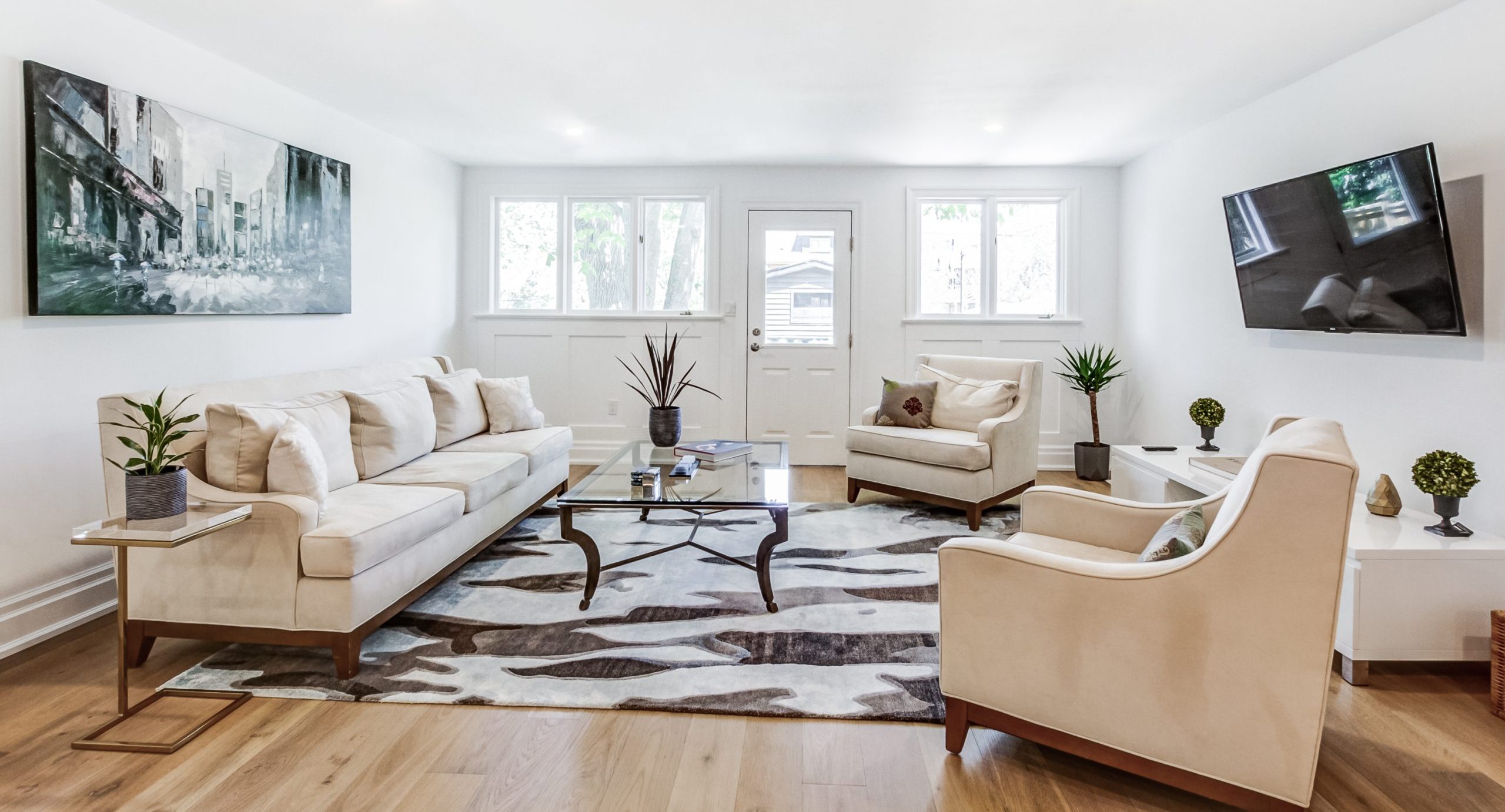
The living-room rug is the largest single decision in the room and the one most often made last, after the sofa is bought and the walls are painted. It anchors the seating, draws the boundary of the conversation area, and does most of the sound absorption in what is usually the loudest room in the house.
It is also the hardest rug in the house to get right, because it has to satisfy two arguments at once. The size and the pattern are settling a design question. The fibre and the pile are settling a durability question. Those two answers pull in opposite directions more often than not, and the room where they pull hardest is this one.
The Short Answer
8×10 at a minimum, with the front legs of every seat standing on the rug. Solution-dyed nylon or wool. Medium pile, a quarter to half an inch. Patterned or multi-toned, not solid. That specification suits most main-floor living rooms in most Ontario houses.
Where we would push back on the usual instinct: go patterned. A solid rug is the more sophisticated-looking choice in a photograph and the harder one to live with, because it shows every spill and, worse, shows the walking path across the room within a couple of years. In a living room with children, animals or regular entertaining, pattern is doing practical work and not just decorative work.
Why This Rug Carries the Most
Four jobs, and the rug has to do all of them at once. It sets where the seating area starts and stops, which in an open-plan main floor is the only boundary there is. It absorbs the sound that would otherwise bounce between a hard floor and a flat ceiling. It softens a hard surface visually, which matters more in a modern house with little woodwork than in an older one full of trim. And it is one of the two or three most visible things anyone notices walking in.
Getting three of those four right and one wrong still reads as wrong. That is what makes this rug worth more deliberation than its price alone would suggest. The zoning job in particular gets bigger the more open the floor plan is — layering rugs over hard floors deals with how rugs mark out zones when the walls have gone.
Sizing It to the Seating
Undersizing is the commonest error in the room and it runs one direction only. These are the three arrangements that work, and the choice between them is mostly money.
| Arrangement | Rug needed | Effect | Use it when |
|---|---|---|---|
| All legs on | 9×12; 12×15 in a very large room | The most generous. Visually expands the room | Formal or large rooms with proportions to carry it |
| Front legs on | 8×10 standard; 9×12 larger | Connected, and the best value in the list | Most rooms. The default modern answer |
| Floating in front | Whatever fits | Disconnects the seating from the rug | Only a genuinely small room |
Avoid the floating arrangement where you can. It is cheaper, and what it buys is a rug that fails at the one job that mattered — if no furniture touches it, it is not anchoring anything.
With a sectional the rule shifts: reach at least the front edge and ideally past it on the open side, which usually means 9×12 and 10×14 for a large U-shape. Full dimensions, including how much bare floor to leave at the walls, are in the room-by-room size guide — and tape the size out on the floor before buying, which catches this in ten minutes.
Fibre for the Traffic the Room Really Gets
Living rooms take real use — people through all day, children on the floor, animals settling in, drinks put down without coasters, dinner eaten in front of the television. This is the room where the durability argument beats the softness argument — the reverse of a bedroom.
| Fibre | Verdict | Why |
|---|---|---|
| Solution-dyed nylon | The standard recommendation for a busy household | Colour locked into the fibre, so it takes strong stain treatment without fading |
| Wool | Equal durability, and it improves with age | Recovers from compression; colours mellow, never patchy. Costs two to four times as much |
| Polyester | Fine in a moderate-use living room | Softer and cheaper, but packs down along the walking line and stays down |
| Polypropylene | Basement family rooms, not main-floor living rooms | Excellent on spills, flattens fastest of the four |
Polyester in a primary living room is the specific mistake worth naming, because it is the fibre that feels best in the showroom and gives up first under exactly this kind of use. Wool versus synthetic rugs compares all four on lifespan and cleaning as well.
Pile Height
Medium pile, a quarter to a half inch, is where most living rooms belong. It takes vacuuming and traffic without visibly crushing under the furniture, and it is comfortable enough for people sitting on the floor.
Go lower, under a quarter inch, if there is a rolling desk chair in the room or if vacuuming happens often — it lies flatter under furniture and cleans faster. Go higher only in a formal living room that is genuinely lightly used; shag feels superb and it mats along the traffic line and crushes permanently under a sofa. In a family room it is the wrong choice however good it feels in the shop.
Pattern, and What It Is Hiding
Pattern is the most consequential aesthetic decision in the room because of its practical side effect. A patterned rug conceals spills, soil and the early stages of a wear path for years longer than a solid one, and the eye reads the variation as design, not as damage. Multi-toned rugs get most of the same benefit more quietly.
Solid rugs have a real place: a room that already has a strong focal point — large artwork, an accent wall, distinctive furniture — where the rug is supposed to recede and give the eye somewhere to rest. Patterned rugs earn their keep in rooms with neutral walls and neutral upholstery, where nothing else is volunteering to be the anchor.
What does not work is two loud things. A boldly patterned rug under boldly patterned upholstery in front of dramatic wallpaper produces a room nobody can settle in, and it cannot be fixed by adjusting any single element. Decide what is going to be loudest before you choose the rug.
This is the room where sizing and fibre have to be settled together. Book an in-store appointment with your room dimensions and a photo of the sofa, and we will work through both in one go.
The Floor Under the Rug
- Hardwood — the most forgiving base; almost anything works, and the contrast between rug and wood is what gives a layered room its depth.
- Vinyl plank — the rug does more here than over wood, because vinyl brings less character of its own for the rug to play against.
- Tile — the biggest improvement of the four. The rug is supplying warmth and softness that tile cannot, which in a January living room is the whole argument.
- Wall-to-wall carpet — possible, and it needs care. The rug has to differ clearly from the carpet in colour and texture, or the layering reads as an accident.
On any hard floor there is a second benefit worth counting: the rug takes the wear the finish would otherwise take, and in a living room that wear is concentrated in the paths between the door, the sofa and the television. Do area rugs protect hardwood floors works through where to place a rug for wear, which is a different map. If the floor itself is not settled, carpet versus hardwood versus vinyl is the layer below this decision.
The Pad, Especially on a Large Rug
Living-room rugs work harder than any others in the house, so everything a pad does counts for more here: it stops the rug travelling under foot traffic, absorbs the compression that wears the pile from its base, and keeps the rug backing off the floor finish.
On a 9×12 or larger it stops being an accessory. On a rug that size the pad is frequently the difference between a rug that still looks good at ten years and one that is finished at five, which makes it the highest-return few percent in the whole purchase. Felt-and-rubber over hardwood, labelled hardwood-safe, two inches smaller than the rug each way — the pad guide has the detail.
Where Living-Room Rugs Go Wrong
- Undersized, so the furniture surrounds the rug without standing on it. Still the commonest, still unfixable.
- A comfort fibre in a durability room — polyester where solution-dyed nylon was wanted.
- No pad, which on a large rug shortens its life by years.
- Too many strong patterns competing in one room.
- A pale solid in a room with children or animals. That decision looks sophisticated for about eighteen months.
Every one is decidable before purchase. The rug mistakes guide covers the full set across every room.
Choosing a Living-Room Rug in Six Steps
- Measure the seating group first, then the room. The furniture sets the size.
- Choose the arrangement — all legs on, front legs on, or floating — and let the budget decide between the first two.
- Answer honestly on traffic, children, pets and food. Pick the fibre from that answer.
- Decide what the loudest element in the room is, then choose pattern to suit.
- Medium pile unless something specific argues for lower.
- Pad on the same order, and see a sample in the room’s own light before committing.
The last step matters most in this room because living rooms have the widest lighting swing in the house — bright daylight through a large window in the afternoon, lamplight in the evening. Showroom lighting is neither. For the full decision from the beginning, how to choose an area rug covers size, fibre and placement together, and caring for area rugs at home covers keeping it looking new once it is down.
Related Guides
A few other guides connected to this topic:
- How to Choose the Right Area Rug for Your Space (Size, Material & Placement Guide) — The complete area rug pillar.
- Area Rug Size Guide (Room-by-Room) — Sectionals, wall margins and every other room.
- Wool vs Synthetic Rugs — The durability argument in full.
- Layering Rugs Over Hard Floors — Contrast, zoning and coordinating with the room.
- Do You Need a Rug Pad? — Most consequential on a large rug.
- Carpet vs Hardwood vs Vinyl: Choosing the Right Flooring by Room — The floor under the rug.
- Best Flooring for Open-Concept Homes — When the living room has no walls around it.
- Flooring Installation — If the floor is going in first.
- Why Alexanian — Rugs and flooring chosen in the same visit.
Want Help Choosing the Right Living-Room Rug?
The best way to choose what’s right for your home is to see the options side by side. Book an in-store appointment at one of our 17 Ontario showrooms and one of our consultants will walk you through what fits your space, your needs, and your budget — or request an in-home visit if that’s easier.
Frequently Asked Questions
What size rug do I need for my living room?
8×10 as a floor, 9×12 once the room is larger, and 10×14 or 12×15 with a big sectional or a very large room. The test is not the room’s dimensions but whether the front legs of every seat can stand on the rug.
Should furniture legs sit on the living-room rug?
At least the front legs, yes. All legs on looks better and costs a size up. No legs on — the rug floating in front of the sofa — disconnects the seating from the rug, and is worth it only in a genuinely small room.
What is the most durable rug for a living room?
Solution-dyed nylon, with wool its equal and better-ageing at two to four times the price. Polyester is acceptable in a moderate-use room and a mistake in a busy one; polypropylene belongs in a basement family room.
Patterned or solid?
Patterned, in most living rooms. It hides spills and the walking path for years longer, which in a house with children or pets outweighs the aesthetic argument. Solid works where the room already has a strong focal point and the rug should stay quiet.
Can I put a rug over wall-to-wall carpet in a living room?
You can, and it works best in a large room where the carpet reads as undifferentiated. Make the rug clearly different in colour and texture from the carpet, and use a pad made for over-carpet use rather than a hard-floor one.